DEEP # 6/2013 (October)If I remember correctly, this is the first time in the 24-year history of Deep columns in Soul Express that I start the column with books reviews. Joe Simon has written a compact and quite good-humoured autobiography, and I called him to receive more information on some events of his life. One of Philadelphia’s premier songwriters, Mr. Bruce Hawes, has also finished his memoirs and below he still adds some comments on his work. Finally the third and the last volume of Bob McGrath’s massive Soul Discography is published. In the CD section there are five quite interesting and worthwhile retrospect compilations reviewed. Content and quick links:Book reviews & interviews:Joe Simon: Don’t Give Up, You Can Make It If You Try, You Can Win Bruce Hawes: Growing up in the Sound of Philadelphia, from the Inside Out Bob McGrath: Soul Discography, vol. 3: N-Z CD reissue & compilation reviews: Carla Thomas: Sweet Sweetheart/The American Studios Sessions and more The Newcomers: Mannish Boys – the Stax, Volt & Truth Recordings 1969 – 74 Darrow Fletcher: The Pain Gets a Little Deeper/The Complete Early Years 1965-1971 King Floyd: I Feel like Dynamite – the Early Chimneyville Singles and more 1970-74 J.P. Robinson: What Can I Tell Her  JOE SIMONConsidering the rich and eventful life Bishop Joe Simon has led, he could have written a thick and comprehensive book, but instead he decided to come up with a compressed and neat report on some of the most significant points in his life and career. He has avoided detailed stories and analyses, business reports and long descriptions and instead has settled for short sentences and laconic and to-the-point style – often quite hilarious, too. My understanding is that this is his means of expression in real life, too.  In Don’t Give Up, You Can Make It If You Try, You Can Win (ISBN 9780615812328; www.spickumpublishinginc.com; 216 pages) Joe writes that he has visited our country, too. Joe: “I was in Finland years ago. That was a good place. I liked it over there. It was in the 60s.” Joe was born on September 2 in 1943, so he recently turned 70. “I never count, because I’m not a birthday person. I never celebrate.” The birthplace was Simmesport, Louisiana, about 80 km northwest from Baton Rouge. “Young people want the bright lights and a big city, and I wanted that as well, but for a home town Simmesport was a very good place for me. I just didn’t have enough to do as a child.” Also one gets the impression that those early days Joe was avoiding work to a degree. “I was very lazy. I was lazy because what was going on there. I didn’t want to do that.” By this Joe refers to the omnipresent cotton-picking. “As a youngster I moved to Oakland – probably in the late 50s – because I was tired of Simmersport, Louisiana. It didn’t have anything to offer me. I thought so at that time, not knowing that - once I became a man - I could look back at that childhood and see that it was a good place to bring a child up.” In California, after his stints with local gospel choirs, Joe joined a doowop group called the Golden Tones and cut as their lead vocalist his first single, Doreetha, for Hush Records in 1959, after which he continued recording solo singles for that same label out of Sunnyvale, California. Only a Dream was the first one, followed by It’s a Miracle. “Doreetha was somewhat different from the average doowop, because I was not a doowop singer and I really didn’t know about doowops. In my home they didn’t allow us to play that type of music. At Hush I was just an artist at that time, but I was always in charge of Joe Simon’s career.” Those days, in lack of money and a place to stay, Joe lived for about two years in a chicken coop in Richmond, California. “It was but as large as a car garage. There was a bunch of chicken. I was in their house, because I didn’t have anywhere to stay.” Already prior to that Joe had gotten a nickname, Pee Wee. “I got it from the older people in Simmesport, Louisiana, because I was a little fellow. I was not tall, when I was a kid.” LET’S DO IT OVERAfter Hush Records, in 1965 Joe for a minute worked with Rick Hall and cut in Muscle Shoals Let’s Do It Over, which was released on Vee-Jay. It was Joe’s first charted single (# 13-r&b). “Mr. Rick Hall was wonderful to work with. He was a nice person and he was trying hard to get more established in the music business when I met him. He needed an artist like Joe Simon, and I needed him. We were able to be a good team.” Joe toured a lot on his newly-found fame. One of the cities he visited often was Detroit, but he never performed at “the 20 Grand” club. “They didn’t except me, because they didn’t know me and didn’t want to know me. They were comfortable by doing the same artists over and over. They also thought that I didn’t have talent.” The Phelps Lounge became Joe’s regular venue in Detroit, and he became a big draw over there. The biggest turning point in Joe’s musical career in the 60s was meeting with John Richbourg in Nashville and starting to release hit singles on John’s Sound Stage 7 label from 1966 till 1970 – first Teenager’s Prayer, then My Special Prayer, Put your Trust In Me and Nine Pound Steel, which became a guaranteed multiple-encore song during Joe’s prison gigs. “John R was a wonderful man. We ended up working like brothers, but he was much older than I was. But we were still able to work together, because he needed me and I needed him, so we went as business partners in the music world.”  THE CHOKIN’ KINDJoe’s first gold record in 1969 was the irresistible The Chokin’ Kind, but surprisingly for Joe it wasn’t such a big deal. “I didn’t like it. Number one, I had lived with it too long and it got old to me, and by me not liking that rhythm & blues life I disliked everything about it – the songs as well as the life-style.” Joe, however, warms to some of his melodies. “My favourite, I think, is a song called Your Time to Cry. It would be the first one that I wrote that was really a wonderful record, and it made Spring Records an international company” (in 1970). Joe had a 25 % share of the Spring company and another notable artist on that label in the 70s was Millie Jackson, an almost opposite to Joe’s more inspirational music style. “It was okay for me working with her, because we only did business together. I try to work with many artists as well as other business people, and I was able to do that and wear all the different hats by being a part-owner of the company. At one point I was the only artist that owned two record companies, Spring and Posse. Posse was formed, because Spring was having problems with Polydor.” Posse was formed in 1980, and Joe had a 25 % share there as well. For Posse Joe recorded such beautiful songs as Glad You Came My Way and Are We Breaking Up? One of Joe’s favourite singers was Bobby Bland, and largely because of Bobby in the early 70s Joe had negotiations with Mr. Don Robey on purchasing Duke for Spring. “The word ‘notorious’ is often used to describe Mr. Robey. “I thought he was very nice. He first started liking me as an artist, and then it grew into a friendship. He liked me, because I was a very obedient person, and I knew my place with him. I always gave him the respect as a man older than I was.” On Spring in the 70s Joe’s numerous hit records included Drowning in the Sea of Love, Power of Love, which was the biggest seller of his career, Trouble in My Home, Step by Step, Theme from Cleopatra Jones, River, Get Down, Get Down (Get on the Floor), Music in My Bones and I Need You, You Need Me. Joe’s backing band was called the Main Streeters (and in the 80s Devastation Band). “I formed that band, when I went on the road after leaving the chicken coop, because my career was starting building at that time.” THIS STORY MUST BE TOLDIn 1988 Joe retired from the rhythm & blues life. “I’m a travelling evangelist now.” He explains his Christian beliefs altogether on twenty pages in this book, and you can visit his present website at www.bishopjoesimonministries.org. First Joe released an album entitled Simon Preaches Prayer on Skull Records, and ten years later, in 1998, they issued a CD called This Story Must Be Told on Ripete Gospel. Wisdom & Understanding with Joshua Simon came out in 2004, and you can read Joe’s comments on that particular record at http://www.soulexpress.net/deep304b.htm. “I Made My Choice” & “What Is Your Choice” two years later on Parliament Entertainment Records contained mainly sermons with occasional singing, but only on a couple of tracks. This means that seven years has passed without any new material from Joe. “We’re trying to get some things ready, and I’ll probably start recording in next weeks.” One thing that certainly has slowed things down was the quadruple heart bypass surgery that Joe underwent in March of 2012. “It was pretty rough to go through that condition, but I’m doing very nice now. I’m looking forward to start travelling and this coming Tuesday (1.10.) I will be in Dallas, Texas.” One thing that’s not very common in music business, let alone in entertainment industry as a whole, is a long and happy marriage. “With Melinee we’ve been together for over fifty years. The other day she asked me that we should be getting married again, and I said ‘honey, wait a minute, if we get married again, I’m really stuck’ (laughing). Don’t Give Up... is an easy read and a very entertaining book. You can read of all the episodes above more in detail, plus about a lot of other interesting incidents during Joe’s career. You can purchase the book at the above Spickum Publishing link or call toll-free 877-805 8447. “I didn’t understand my life until I wrote it down, because it looks different in writing than it does just talking about it. I’m totally surprised at some of the things I went through. There are also a lot of things in the book that are very good for the family, as teaching them how to do things and have self-motivation as well.” (The interview was conducted on 29.9.2013; acknowledgements to Bishop Joe Simon and Gwendolyn Harney).  BRUCE A. HAWESI talked to Bruce almost exactly ten years ago while writing the Spinners Story and shedding light on the three writers that wrote many of the biggest hits for the group – and producer Thom Bell, as well - in the 70s, Jefferson-Hawes-Simmons. You can actually read those extracts again at Bruce Hawes interview (The Spinners Story, part 4, in Soul Express # 3/2003).  After years of writing, Bruce has finally published his autobiography, and, as far as I know, Joe Jefferson is also in the process of writing his book. In my copy of Bruce’s book, Growing up in the Sound of Philadelphia, from the Inside Out (M.A.W.A.com Inc. Enterprises Publishing Housing Division; ISBN 978-0-615-68946-3; 212 pages) it reads “this is the first limited edition and not completely formally edited (Reader Friendly)”. Bruce: “The first edition is my personally finished version of the book. The ‘not formally edited’ statement is a disclaimer quote that was placed in the book. This first edition of my book was initially edited with a team over the years. Ultimately, I had to re-do and write the book again, word for word, from start to finish. And just in case somebody does notice any small errors, I can re-release it later.” “I began writing this book in 2009, when I registered the title for it with the Library of Congress. This book that I have now released is straight from the author’s desk directly to the fans of TSOP (The Sound of Philadelphia), so to speak of it. I really had to get this book to the fans, who literally demanded and pleaded for me to release it. So I worked on it every day since December of 2012 to do so...” “This book is a testament of how I wrote, edited and graphically laid it out on my own from the inside out. Eventually it will be released as a phone app., and also will be made available in an eBook format... and it will be distributed to the bookstores.” What I like most in this book is Bruce’s enthusiasm; the way he gets carried away in describing or explaining something and how his stream of consciousness takes him away to numerous sidetracks. It doesn’t bother me. It is fun to read, and you can really sense his excitement. 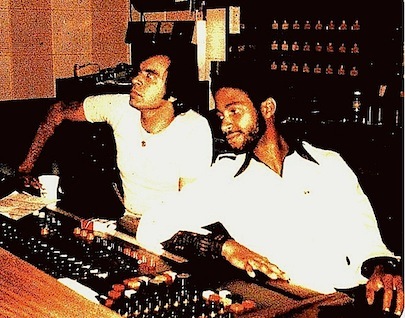
On the pic above: Bruce in studio together with Carl Paruolo First and foremost, I wholeheartedly agree with Bruce on his praising the late Bobby Martin as ‘the elder statesman of TSOP’. I also think that in the music history Bobby was and is hugely underrated. After that tribute Bruce starts writing about his own musical history, from the gospel choir beginnings both as a singer, and a composer, to his first secular song, I Could Never Repay Your Love, which Thom Bell chose for the first Spinners Atlantic (gold) album in 1973. Here I wish that Bruce had picked a better Thom Bell bio from the internet, especially in terms of Thom’s early career. First Thom Bell made Bruce and Joseph Jefferson a pair, and later added Charles Simmons to the team (so this is somewhat contrary to what Joe says in his bio), and their first joint song as a threesome was Could This Be the End for the Stylistics in 1973. Bruce has a lot of good things to say about many of his colleagues within the Mighty Three Music sphere, at Philadelphia International Records and in Philly music in general. He speaks fondly of Thom Bell, Gamble & Huff, Theodore Life, Linda Creed - their first collaboration was Foolish for Johnny Mathis – Jack Faith, Bunny Sigler, Bobby Eli, Rena Sinakin and many, many others. In later years some of those, who strongly affected Bruce’s life and career, included Norman Harris, Jimmy Bishop (in a negative way), Melba Moore, Stevie Wonder and Phyllis Hyman. However, the closest person for Bruce and the love of his life was the late Barbara Ingram – one of the Sweethearts of Sigma Sound along with Carla Benson and Evette Benson - but a couple of tragic incidents separated them for ten years till the mid-80s, and they never got married. It was also interesting to read about Bruce’s production work on the Soul Devalients/the Force of Nature and MFSB, his background singing in Thom Bell’s recording sessions and his arranging assignments (Bingo for the Whispers). There were often interesting and even funny twists to those duties. Bruce openly describes some of the more unhappy turns in his life as well, such as the staff revolt at PIR in 1975, payola investigations, him leaving PIR in ’77 and not receiving any royalties after that, friends stealing his creative work – actually, I almost got furious and mad at Bruce when reading how easily he gave away his writing credits – and two muggings with gun shots. Here we don’t get any details, except that I think Bruce had to spend some time in a wheel-chair in the 90s. He also doesn’t reveal almost anything about his ex-wife, Crystal. Those non-exposed episodes aside, in terms of song-writing – how the songs come about - and creation of music and the 70s Philly music scene as a whole, this is a very lively and interesting book that will, I’m sure, eventually find its way to book-shelves of Philly music fans. SOUL DISCOGRAPHYWhen an artist or an author says that his new product will come out in a few months, many of us automatically conclude ‘aha, we’ll get it in a year or so... or perhaps later’. Bob McGrath’s Soul Discography, vol. 3: N-Z (ISBN 978-0-9866417-2-5; www.eyeballproductions.com; 764 pages) was to be published approximately a year ago, but, I for one, am glad that it’s finally here – with 3 581 artists covered this time, out of the total number of 10 184. Again I refer to my review of the first volume at http://www.soulexpress.net/deep410.htm#souldiscography, and would like to repeat Bob’s three main criteria in choosing the artists: no Caucasians, no jazzers and no kiddie stuff, meaning post-1980 starters. In this third volume almost all the qualified artists have their product listed till present times. Had the compilers visited our site, they could have still added more recent material, for instance, from L.J. Reynolds, Peggy Scott-Adams, Bunny Sigler and Spencer Wiggins. Here I also can’t help bringing up the big blunder with the Manhattans’ early recordings in the previous volume. After all, we’re talking about a renowned group. You can check the correct info in our Manhattans story. But those are really minor remarks, and as a whole this is an ambitious and enormous work. We must be truly grateful to Bob for finally being able to read the first detailed and finished reference book of our genre. For serious soul music fans this is an essential purchase. You can even discover such new and significant matters as the existence of one single released in 1968 by a group called Soul Express, out of Sioux Falls in Maryland.  COMP-ART-mentCARLA THOMASSweet Sweetheart/The American Studios Sessions and more (Stax/Ace CDLUX 012; www.acerecords.com; 23 tracks, 66 min; notes by Tony Rounce) lets us hear the shelved album that Chips Moman produced on Carla at the American studios in 1970. Out of those ten songs only two were released as a single, the very slow I Loved You Like I Love My Very Life (Phil Spector used this song, too) backed with Goffin & King’s “cabaret” finger-snapper, Hi De Ho (That Old Sweet Roll). They relied on familiar tunes a lot. James Taylor’s Country Road gets a poppy treatment, Free’s Heavy Load is actually quite heavy... and futuristic, and Ray Stevens’ inspirational ragtime hand-clapper Everything Is Beautiful comes out as all-embracing as you can imagine. Bee Gees’ To Love Somebody has always been one of my favourite melodies, and here Carla approaches the song with a right portion of intimacy and emotion. Heaven Help the Non-Believer is a pretty and melodic ballad, Sweet Sweetheart – again by Goffin & King – is a poppy and catchy toe-tapper and I Think I Love You Again is another tender and beautiful downtempo song. Compared to Carla’s released output those days, this album was more pop-orientated and it’s difficult to say how successful it would have been. But at least I like to listen to it now. The rest tracks on this CD are Carla’s unissued cuts between 1964 and ’68. There are eight different takes - on such songs as B-A-B-Y, William Bell’s Crying All by Myself, Mann & Weil’s swayer Good Good Lovin’ and a soulful ballad called Problems. The one demo cut is a slow pleader titled Give It a Try, and then we have three otherwise shelved tracks. Hayes & Porter’s Love Sure Is Hard Sometimes is a snappy, quick-tempo mover, James Brown’s Try Me is covered in a traditional, old-fashioned style and finally Stop By Here is a convincing soul ballad and definitely worth issuing at any time.  THE NEWCOMERSRandy Brown, Bertram Brown, Terry Bartlett and William Sumlin formed a group that became one of Memphis’ best-kept secrets. They were actually better known in a re-incarnation called Kwick in the 80s with a couple of small hits on Emi America. Mannish Boys – the Stax, Volt & Truth Recordings 1969 – 74 (CDLUX 010; 24 tracks, 77 min., notes by Tony Rounce) compiles for us their six singles on three Memphis imprints and as a bonus gives us thirteen unissued tracks, nine of which are demos. Presumably Stax used this group a lot as background vocalists and they say that the Newcomers used to open regularly shows for Al Green.  Randy Brown, who left the group in the summer of 1970, is the key singer on those early recordings. On some tracks he sounds remarkably like David Ruffin. However, Stax clearly didn’t know which direction to take this talented group in. They first tested with catchy dancers (Open up Your Heart and You Put the Sunshine Back in My World) and then nursery rhyme related novelty ditties (Pin the Tail on the Donkey - # 28-soul, # 74-hot – The Martian Hop and Humpty Dumpty). In 1974 they had some success with the disco sound on Keep an Eye on Your Close Friends - # 66-soul – and The Whole World’s a Picture Show. Especially on soulful slow songs the group could display its skilful harmonizing and impressive vocal interplay. Mannish Boy and (Too Little in Common to Be Lovers) Too Much Going to Say Good-Bye (# 74-soul), which Randy Brown later covered on his Welcome to My Room album, are the best examples. Personal favourites among those thirteen unissued tracks are two deep ballads - Betcha Can’t Guess Who and the 6-minute The Exit – one dance-floor filler (See Saw Lovin’) and a fast and very catchy number named Sweet Purity, written by Mack Rice, Tommy Tate and John Gary Williams.  DARROW FLETCHERDarrow’s late 70s Crossover recordings were released last year, and now we get his output from the preceding decade on The Pain Gets a Little Deeper/The Complete Early Years 1965-1971 (CDKEND 403; 23 tracks, 60 min.; notes by Robert Pruter and Ady Croasdell). His early work was spread on fourteen singles on six labels: four on Groovy (1965 – ’66), three on Jacklyn (1966 – ’67), three on Revue (1968), one on Congress (1970), two on UNI (1970 – ’71) and one on Genna (1971). Two of them charted, The Pain Gets a Little Deeper in 1966 (# 23-r&b, # 89-hot) and I Think I’m Gonna Write a Song in 1970 (# 47-r&b). I’m not a big fan of teenage voices, especially on formulaic dancers. Here, however, on some tracks good melodies with rich orchestration save a lot and make them work. The Pain Gets a Little Deeper, What Good Am I Without You, the tuneful Changing By the Minute and the motownish Gotta Draw the Line (recorded earlier by the Three Degrees) are indeed exhilarating dancers. The eight slow and mid-tempo tracks vary from pubescent pop (Those Hanging Heartaches) to post-hippie pseudo-art (Now Is the Time for Love). However, I’m sure that all the NS fans value the rest 15 uptempo tracks.  KING FLOYD* Considering that among soul singers King Floyd has never been on top of my list, I succeeded in surprising even myself by liking his new retrospect compilation a lot. His funky tracks never were nasty or in-your-face blasts, but instead quite soft, even sophisticated, and always quite memorable. On the mellow side for some reason I’ve tended to connect him with Arthur Conley, perhaps because in their smoky voice they’re both masters in delivering deep soul in a similar style. And King Floyd was more popular than I had realized. For instance, on this compilation there are as many as seven charted songs – the golden Groove Me and Baby Let Me Kiss You, Got to Have Your Lovin’, Woman Don’t Go Astray, Think About It, So Much Confusion and I Feel Like Dynamite. King started his recording career in L.A. in the mid-60s (see the attached single scan), and in 1970 drifted into Jackson, Mississippi, to record at the Malaco Studios. I Feel like Dynamite – the Early Chimneyville Singles and more 1970-74 (CDKEND 404; 24 tracks, 77 min., liners by Tony Rounce) contains his ensuing eight singles and tracks from his two Chimneyville albums, three from King Floyd (’71) and six from Think About It (’73). King himself wrote most of his songs, they were produced by Elijah Walker and arranged by Wardell Quezergue, who actually was the real producer as well. Besides those big hits, there were other nice mid- or uptempo cuts, too – a gentle mid-pacer called What Our Love Needs, a poppy toe-tapper named It’s Wonderful and a tuneful jogger titled Thank You. Among emotive slowies there are the deep Please Don’t Leave Me Lonely, the sweet and over 6-minute long My Girl, the touching You’ve Got Me and the pleading Handle With Care. Now you can surprise yourself and purchase this praiseworthy CD.  J.P. ROBINSON*I’m aware that What Can I Tell Her (Soulscape, SSCD 7031; www.garryjcape.com; 20 tracks, 56 min., liners by John Ridley) was released already during the summer, but it’s such a good record that it deserves attention, even belatedly. In chronologic order, this set offers music from John Pooderue’s seven singles on Alston (1968 – ’70), three on Atco (1971 – ’73) and one on Blue Candle (in 1974). The producers and the main writers were Brad Shapiro, Steve Alaimo, Clarence Reid and Willie Clarke. J.P., who is 75 years old today, started his recording career with the Chanteers in the early 60s and - prior to meeting Mr. Henry Stone in Miami - cut one single in a duo called Vick & John in the mid-60s. On Atco in the early 70s, J.P. recorded four versions of familiar, non-Miami tunes, such as a churchy delivery of Bob Dylan’s pop & folk song George Jackson, an intensive but different approach to Solomon Burke’s magnificent The Price, a good country-soul take on Conway Twitty’s # 1 hit, How Much More Can She Stand, and a convincing reading of one of my favourite soul tunes, Don’t Take My Sunshine, but here, however, I think that Johnnie Taylor delivered the ultimate version. On the uptempo front (six tracks), disco sound was pushing through on J.P.’s ’74 Blue Candle single, Keep Me Satisfied/Our Day Is Here in 1974, and among the four mid-tempo tracks personal favourites include the haunting You Got Your Thing on a String (# 46-soul in 1969) and the easily flowing Keep On Holding On, which sound-wise could have been cut in Chicago. Besides those four Atco sides, among down-tempo songs there are three more soul ballads that I’d like to bring up – Only Be True to Me, What Can I Tell Her (# 39-soul in 1970) and the impressive Please Accept My Call. If this music doesn’t touch your soul, please check that you have one. © Heikki Suosalo Back to Deep Soul Main Page Back to our home page |
