Soul Express Interview/Article
By Heikki Suosalo
DENIECE WILLIAMS
Part 2 (1975 – 1981)

Deniece had six
singles released as Deniece/Denise Chandler on two local Chicago labels,
Toddlin’ Town and Lock, in the late 60s. After that she worked on and off with
Stevie Wonder as a member of Wonderlove in the early 70s, but it
was her second attempt at a solo career in the mid-70s that made her a
household name in music for years to come.
Deniece: “When I
was with Wonderlove, Stevie gave ten minutes to perform before he came on
stage. I had written a song called Free with some of my band members –
some of the other members in Wonderlove – and that was one of the songs that
Stevie chose for us to perform. One night I would perform Free, and Earth,
Wind & Fire was in the audience. After the concert Maurice White’s
attorney came up to me and said ‘boy, we really love the way you sing and we
really love that song you sing. Who wrote that song?’ I said ‘well, I did
with some of the members’. He asked ‘do you have more songs’, and I said
‘yes. I’m writing. I have a lot of songs’. He gave me his card and asked me
to send him some songs.”
I thought he
wanted to hear the songs for Earth, Wind & Fire, because Philip Bailey (on the pic above
together with Niecy) and
I have a similar octave range. I got a call in about a month saying that
Maurice White had just started his own production company. He had just signed
a girl group called the Emotions and he was looking for a female solo
artist, and he was interested in me. I was blown away.”
Deniece sings
background on Flowers and Rejoice, the first two big albums the
Emotions had on Columbia with Maurice White in ’76 and ’77, and she knows the Hutchinson sisters already from her earlier days in Gary, Indiana. “We’ve worked together
all these years, and we’re very close.”
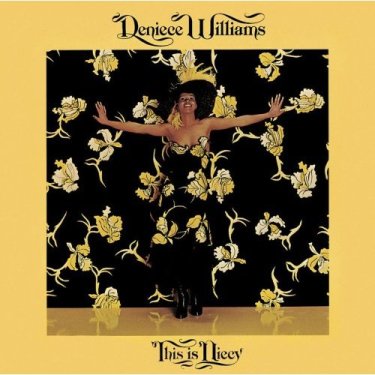
THIS IS NIECY
Deniece’s debut
solo album, This Is Niecy (Columbia 34242), was released in the latter
part of 1976, and it gave her a jumpstart by striking gold straight away. On
Billboard’s charts it peaked at # 3-soul and # 33-pop. The set was produced by
Maurice White and Charles Stepney, who had formed Kalimba Productions.
Deniece was the first female solo artist in that company.
“That will
always remain special in my heart, because it was first. Certainly it’s not
the only project that has such an incredible feeling, which makes you wonder
‘how did I do that’, because even working with Thom Bell on projects
that we did together… they’re timeless. It wasn’t only the songs, it wasn’t
only my voice – the productions are timeless.”
“I loved working
with Maurice White. He was very different from Stevie. With Stevie we’d get
on stage and we’d have fun. He’d get up there and start writing new music, and
we’d be singing and acting like we have rehearsed it all the time. We were
very loosey-goosey, but incredibly creative. Maurice was very precise. He was
putting on one of the most incredible shows in show business at that time. He
taught me the business of music, and planning and executing a plan and
executing a show.”
Charles Stepney
first had his own jazz group in the fifties, and then became a music supervisor
at Chess Records in the 60s, where he arranged, wrote and produced not only for
blues musicians, but also for such artists as Ramsey Lewis, the Dells and
Minnie Riperton. “For me he was so lovable. He’s probably one of the
most incredibly talented arrangers that the music industry ever had. He was a
very integral part of my music and the whole production and arrangement of my
music and my voice. There’s only been one other person in my musical life that
has understood my music the way Charles Stepney did as an arranger, and he is
Thom Bell.” Charles died of a sudden heart attack in May 1976.
FREE
A haunting beat
ballad titled Free was released as the first single, and in late 1976 it
went up to # 2-soul and # 25-pop and all the way to number one in the U.K. Deniece and Susaye Greene are two of the four writers of the song, alongside Nathan
Watts and Henry Redd. “I think it was the combination of the song
itself and what the song said lyrically. It’s amazing when you can write a
lyric and you think you’re the only person that’s having this experience. Then
you put it out there and you find out that millions and millions of people feel
the same way. I think that is what happened with Free. People really
do want the freedom to be themselves and to have self-expression. Also
somebody told me that I was the first woman that they heard in music that told
those women at that time that ‘you don’t have to stay’. I thought ‘well, I
didn’t mean to tell them that, but I guess it is okay’ (laughing). Free
is also Deniece’s own favourite of all the songs she’s recorded. “I think Free
will always be very special in my heart.”
The flip side, Cause
You Love Me Baby, the song that Deniece covered for her recent Love,
Niecy Style CD, charted on its own (# 74-soul). All seven songs on the
album were written or co-written by Deniece, and for the follow-up the company
picked a sweet and innocent mid-pacer called That’s What Friends Are For (#
65-soul, # 103-pop), written by Deniece and Lani Groves from Wonderlove.
Among the rest
of the songs there are a couple of beaters, one mid-tempo song called Watching
Over that EW&F contributed and as a closing number an interesting,
almost 8-minute-long jazzy slowie named If You Don’t Believe. In 2005
Sony released the album in a CD format with the single version of Free as
a bonus cut.

SONG BIRD
The second album
called Song Bird (Columbia 34911) was released a year later, but there
weren’t any hit songs to pull it off anymore (# 23-soul, # 66-pop). The only
single release off the album, a melodic mover titled Baby, Baby My Love’s
all for you (written by Verdine White and Robert Wright)
peaked at # 13-soul, without any ‘pop’ show. Produced by Maurice White and Jerry
Peters, of the eight songs on the album, Deniece this time wrote only two
and co-wrote two more.
“A lot of things
happened with the second project. One that I think had the most impact on my
project and the subsequent projects with the Emotions and Earth, Wind &
Fire was that Charles Stepney passed away. He was a very, very important
ingredient to the production and the arrangement of the music.”
“Secondly, for
some reason at that time Maurice White did not want to continue recording my
music on me. My first project was all of my music. When I became popular, all
of a sudden a lot of other people in the industry started sending us music, and
instead of us sticking to the winning formula he started going for other
music.”
“I think the
success of my first project was because it was my music expression for my
voice. We went out and we did some different music, and then he brought in
another arranger, who’s very, very gifted and talented but was not correct for
me, and that was Tom Tom 84. It wasn’t the same arrangement or the same
feel, and the whole situation changed up and I think we did a project that was
good but we didn’t do a project that had the magic of the first one, because
the players and the music changed.”
The album
contains a few poppy, almost sing-along type of songs (The Boy I Left
Behind, We Have Love for You, Season). There’s also one fast chugger (Time),
one “fiesta” ditty (Be Good to Me), but the two songs that Deniece wrote
stand out. God Is Amazing is a vocally powerful, slow inspirational
testimony, whereas the concluding The Paper again is a meditating,
experimental and slightly jazzy slowie – in the vein of If You Don’t Believe
- and the running time again is close to eight minutes.
Those days
Deniece was supposed to produce an album on a group called the Lollies.
“I was so busy with my own career and busy raising my children. We started to
work on the Lollies, but also that was during the time I was with Maurice White
and they didn’t have any interest in what I was trying to do at the time.”

TOO MUCH, TOO
LITTLE, TOO LATE
A pretty and
melodic duet with Johnny Mathis called Too Much, Too Little, Too Late
became the second biggest hit in Deniece’s career in early 1978. Written
by Nap Kipner and John Vallins, it struck gold and in April shot
to the very top, both on pop, and soul charts. The two singers were put
together by Jack Gold, former president of CBS, and Mike Dilbeck
from a&r department at CBS. It was also Johnny’s first number one hit in
the r&b/soul field (he had enjoyed one on the pop side in 1957 with Chances
Are), and it was Johnny’s first duet. For Deniece it was her second, since
she had cut a single with Lee Sain already in 1969. The flip offered
another sweet song titled Emotion.
“I loved Johnny
Mathis. He was one of my mom’s favourites. I’ve grown up listening to him,
and actually rehearsing with him for years. When he was on television, I’d be
singing along and then I harmonized with him. So when I got a call saying
there was some interest in him and me doing a duet together I said ‘oh, my
God’!”
The album called
That’s What Friends Are For (Columbia 35435) was quick to follow in the
summer of 1978, and interestingly it didn’t include the Too Much… hit on
it. But it hit gold, too, and reached # 14-soul and # 19-pop. Produced by
Jack Gold, arranged by Gene Page and recorded at A&M Studios in
Hollywood, among the musicians you can spot such names as Greg Phillinganes and
Sylvester Rivers on keyboards, Michel Rubini on piano, Paulinho
da Costa at percussion, David T. Walker, Wah Wah Ragin and Lee
Ritenour on guitar, Scott Edwards and Lee Sklar on bass, Ed
Greene and Mike Baird on drums and Ernie Watts on tenor
saxophone. Maxine Waters, Lani Groves and Jim Gilstrap are on
background vocals, and there’s no way we can ignore the big sections of
violins, violas, cellos, French horns, flutes and even harp.
“It was just so
much fun working with Johnny. He’s such a gentleman. I’ve never met a more
humble spirit in someone, who had every right not to be humble. He really
taught me the value of humility in the midst of your success. I wish we had
done more touring, but you could tell his schedule two years in advance at that
time. He was totally booked up. They weren’t prepared for this little girl that
showed up” (laughing).
YOU’RE ALL I NEED TO GET BY
The follow-up
single was a cover of You’re All I Need to Get By (# 10-soul, #
47-pop). “That was Jack Gold’s idea. He loved that song. He loved Marvin
Gaye’s and Tammi Terrell’s rendition and I loved Marvin’s and
Tammi’s rendition, and I was also a big fan of Ashford & Simpson, the
writers. So we all wanted to do the song.” Marvin and Tammi hit number one
with the song ten years earlier on Tamla.
Among the other
old and tested songs there are sweet and at times quite MORish interpretations
of Until You Come Back to Me, Heaven Must Have Sent You and the title
song, That’s What Friends Are For, which was borrowed from Deniece’s
first solo album. As a single release, however, it didn’t chart for Deniece
and Johnny. On Billy Joel’s Just the Way You Are, Stevie Wonder
does the harmonica solo.
“With Johnny we
had tremendous fun together. We did the performance for Prince Charles and a
lot of television together. We sang a lot of our songs in Spanish. He knew my
music and he really gave me the confidence in the fact that musically I was
doing the right thing for me.” Deniece and Johnny sang together on a theme
song for a television sitcom called “Family Ties” in the early 80s. The hooky
mid-tempo number, written by Tom Scott and Jeff Barry, was titled
Without Us. Furthermore, there were other worthwhile releases around
the corner for the duo, but we’ll get back to them a little later on.
Sony released
the ten-track-album (That’s What Friends Are For) as such in a CD format
in 2001, and there’s also a Sony CD by the twosome from 1995 called Too
Much, Too Little, Too Late, but it features only four duets (Too Much…,
Emotion, You’re All I Need To Get By, Love Won’t Let Me Wait), while the
rest eight tracks are familiar solo recordings by both Deniece and Johnny, four
from both.
Those days
Deniece talked about her desire to get into acting. “I thought about the
acting and I had the desire, but you still have to understand that I came into
the industry with children. I was still a mother, and I wanted to be a mom,
and there are only so many hours of the day. I made the right choice. My
mother was very instrumental in my success, because she helped me with
children. She was there from the earliest day of my career, and I could not
have done it without her.”

I’VE GOT THE NEXT DANCE
Deniece’s next
album in 1979 appeared on a label that Maurice White had launched a year
earlier - ARC, American Recording Company, which was distributed by Columbia. When
Love Comes Calling (ARC 35568; # 27-soul, # 96-pop) was this time produced
by David Foster with the exception of three tracks that Ray Parker,
Jr. produced. Deniece was the co-producer, and she co-wrote six out of the
ten songs on the album. The corresponding CD release on Columbia came out in
2004.
A 14-time Grammy
Award winner, David Foster (www.davidfoster.com)
is one of the most successful producers and songwriters in pop and rock music.
He was a keyboardist in an early 70s group called Skylark (Wildflower),
then went on to work with EW&F, Hall & Oates and Kenny
Rodgers and hit big-time in the 80s, 90s and in our decade with such
artists as Diana Ross, Chicago, Neil Diamond, Celine Dion, Natalie Cole,
Barbra Streisand, Whitney Houston and Toni Braxton. He also became
the vice president of Atlantic Records in 1994.
But all those
grandiose achievements came about after Deniece’s When Love Comes Calling,
which in terms of success still wasn’t exactly a triumph. “I was introduced to
David Foster through Maurice White. I was still with Earth, Wind & Fire at
the time.” The first single, the sharp and hard-hitting I’ve Got the Next
Dance (# 26-soul, # 73-pop), was actually Deniece’s first authentic disco
recording. “That’s the first disco single. I didn’t really want to do it,
because I didn’t consider myself a dance artist. But, once again, Donna
Summer had come in and changed the record industry – and the music was
changing – and every record label wanted their artists to try to do some kind
of a disco song.”
The second
single off the album, I Found Love (# 32-soul, # 105-pop), was also a
disco release, although slower in tempo and softer in beat, and - while on
dancers - Like Magic, an album track written by Robert Wright and
Geary Lanier, bears a slight resemblance to Natalie Cole’s hit, This
Will Be, four years earlier. Among the romantic slowies on the album there
is a serenade called Touch Me Again, also the inspirational God Knows
and Why Can’t We Fall In Love?, co-written by Carole Bayer-Sager
along with Deniece and David.
TIME HEALS EVERY
WOUND
James
Carmichael of the Commodores fame was supposed to be the next
producer for Deniece. “I had a lot of respect for James Carmichael. He was
making wonderful, wonderful music with the Commodores. But I think the magic
was James with the Commodores. When I got into the studio with him, we didn’t
have that musical magic happening, so we had to stop that project and do
something else.”
Deniece’s actual
next performance on record was with Michael Zager, when she became the
featured vocalist on a lovely “nightingale” ballad called Time Heals Every
Wound on Michael’s album simply titled Zager in 1980. Why this
crystal-clear interpretation missed the charts altogether, remains a mystery. “I
was in New York and meeting with a lot of songwriters from various companies.
Michael and I met, and I met his wife and his children. He met my sons, and we
ended up going out fishing and hanging out and writing, so that’s how that came
about.”

MY MELODY
In his formative
years Thom Bell (b. in 1943, on the pic above) studied to become a concert pianist, but at
sixteen he played drums and percussion, too, and in later years he was already
able to play nineteen instruments. As a teenager he was doing recitals with
his family. In the late 50s Thom met Kenny Gamble and as Kenny and
Tommy they had their first single released in 1962 on Heritage Records (Someday/I
get by). Thom played with the Romeos for about two years, but he
had left the group by the time they started recording as Kenny Gamble & the
Romeos.
After touring as
a pianist and conductor with Chubby Checker, Thom went on working at
Cameo-Parkway as a studio musician. His first production in 1966 was for a
label called Moonshot. The song was called He Don’t Really Love You,
and at the time of the recording the group was called simply the Five Guys,
later renamed the Delfonics. Thom produced numerous hits for them up to
1970, when William Hart took over. Already a year earlier Thom went
with Gamble & Huff to be an arranger for them (mainly on Neptune), but his next big project was the Stylistics. Starting from 1971, during
the next three years he and Linda Creed composed many unforgettable
songs for the group, but from 1972 onwards he more and more concentrated on his
main 70s project, the Spinners. Although Thom worked with them for
seven glorious years and produced nine albums, he had the energy and creativity
to work in the 70s with dozens of other renowned artists, too. The first
masterpieces in the 80s he produced together with Deniece Williams.
Deniece: “I’ve
known about Thom Bell’s music over the years... what he was doing with the
Stylistics, which I absolutely loved, and the work he was doing with the
Spinners and the work he did with Dionne Warwick. He had also done
something with Johnny Mathis and with Elton John. I have tremendous,
tremendous respect and love for his work.”
Thom: “I heard
about Deniece from Stevie Wonder. Stevie’s a good friend of mine, and she was
doing background for Stevie Wonder. She also did background for Maurice White
of Earth, Wind & Fire.”
Deniece: “When
we were looking for another producer, I mentioned to my manager at the time
that I felt that he would be someone that would be great for me. They put the
wheels in motion and Thom and I got together, and – boy! I have to say – outside
of working with Maurice White and Charles Stepney, Thom Bell was the closest to
that particular sound.”
Thom: “Her
boyfriend at the time was from Jamaica and he was Bob Marley’s manager.
His name was Don Taylor. I knew Don Taylor years ago. When we were
kids, we used to go to the Jamaican clubs in New York, Philadelphia, Baltimore and Washington. Each area had its own Jamaican clubs. Not only Jamaica, they would have Barbados, they would have Trinidad…”
“Years later Don
Taylor called me on the telephone and asked me, if I’d like to produce Deniece
Williams. I knew who she was. I just didn’t know her. She was selling records,
but she was only selling records in the r&b end. She wasn’t selling
records in the pop end, the big money market end, and that was my forte. I was
lucky enough to be able to sell records in the pop end as well as r&b end.”
“They wanted a
black producer to work with her. Then I talked to Maurice White, who had her
at the time. My people, my management, got together with the Columbia people
to put the deal together, because we went to the people who paid the money.
The one to pay the money was Columbia, not ARC. ARC is being paid by Columbia, and I don’t want to be paid by them. I want to be paid by Columbia. This way
you can be sure of getting your money. Not to say that they didn’t take care
of business, but I go directly to the source. That’s how I got to work with
Deniece.”

Their first
collaboration, a lovely and classy album called My Melody (ARC 37048),
was released in the spring of 1981, and on Billboard’s charts it reached #
13-soul and # 71-pop. Sony released it on a CD in 1990. Produced by Thom and
Deniece and arranged and conducted by Thom, the set was recorded at Sigma Sound
Studios in Philadelphia and the players in the rhythm section include Bobby
Eli and Bill Neale on guitars, Thom Bell and George
Merrill on keyboards, Bob Babbitt on bass, Charles Collins on
drums and Larry Washington and Ed Shea on percussion.
WHAT TWO CAN DO
Of the eight
songs on the album, Deniece and Thom composed six. Thom: “I was very lucky
that after Linda Creed I could work with Deniece. Deniece was a writer and I
was a writer, so I said ‘let’s try it together’. I was extremely lucky that we
found each other. It’s like after Baker, Harris and Young, I
needed a good bass player, guitar player and drummer and I was lucky enough to
find Bob Babbitt on bass, Charles Collins on drums and my brother Tony on
guitar.”
“The way I
usually work is that I write the melody first and then I turn it over to
Deniece and tell her what I think about it. I don’t instruct her, because
she’s the lyricist, not me. With Creed it wouldn’t take long at all. Betcha
by Golly, Wow would take a day, or You Make Me Feel Brand New two
days… something like that. With Deniece it was the same thing. She was very
quick. When I write, I write a specific melody. You have to write to that
melody. You can’t change the melody. It’s kind of hard, I guess, but it’s the
only way I know. Once I have that melody down, that’s it. I can’t change it.
The way she worked was fantastic. She’s a very good writer.”
Considering the
wealth of gorgeous mid- and down-tempo songs on the album, it was a bit
surprising that for the first single they chose a mellow dancer named What
Two Can Do (# 17-soul). It is quite catchy, though. Thom: “The company
picked it up. My thoughts are one thing, their thoughts are something else.
The company has to market and promote their product, so I usually listen to
them.”

SILLY
A haunting
mid-tempo floater called It’s Your Conscience – although a marvellous
tune - didn’t fare that well, either (# 45-soul), but the song that had the
strongest staying power and enchants people still today is the subtle and
beautiful Silly (# 11-soul, # 53-pop). Thom: “Deniece had the song and
she was trying to figure out how to do it, so I said ‘let me work on it a
couple of minutes’ and I musically rewrote it. I just rewrote it as an
arranger, not as a songwriter. She had written that song years ago with
another girl, a very nice girl, who was a school-teacher. They went to collage
together.”
The other girl in
question was Fritz Baskett, who in the early sixties was a member of the
group called the Hi-Fi’s, which turned into the Vocals and
recorded one single on Ray Charles’ Tangerine Records. In the early 70s
she sang in a group called Sweet Salvation. The third writer of Silly
was Clarence McDonald, a renowned keyboardist, producer, arranger
and writer (www.clarencemcdonald.com).
Other highlights
on the album include two classy and infectious mid-tempo songs, My Melody and
Suspicious, and as the final tune Sweet Surrender, which has a
more complex, almost classical structure and arrangement. It doesn’t hit you
instantly. Thom: “That was one of my oddballs. In every production I do one
that I know is not really commercial. It’s more of a something for myself.
That particular song was from my classical background. With the Stylistics it
was People Make the World Go Round and with the Delfonics it was Ready
or Not Here I Come.”
Deniece: “Some
of my favourites of the songs I did with Thom Bell were probably the songs that
people don’t hear. I thought Sweet Surrender was wonderful. Others
that I liked were My Melody and Silly.”
This gem of an
album and magnificent piece of classic soul music was followed by another
masterpiece a year later. We’ll carry on with Deniece and Thom and discuss
that album in the third and – I promise! – final part of the story soon. There
simply was too much material left to include it all in this second part. We
still have such songs as It’s Gonna Take a Miracle, Let’s Hear It for the
Boy and Black Butterfly ahead of us; and eleven more albums to go!
Meanwhile, please visit Deniece’s website at www.denieceniecywilliams.com.
(Additional
acknowledgements to Mr. Thom Bell).
The Philip Bailey & Deniece photo courtesy of Bobby Eli
Heikki Suosalo
Back to
our home page
|
