DEEP # 2/2018 (June)I have two excellent books to begin with, and I’ll present them in chronological order, based on their contents. The first book concentrates on the music created in the 1950s and 1960s, whereas the second one surveys records mainly from the 1960s and 1970s. For record collectors and music enthusiasts, both are essential. Alongside reading, I’ve lately listened to some sweet soul sounds from the past and also to the latest CD by Peggy Scott-Adams, which in a way also takes us back in time. The last time I was in touch with Peggy was already six years ago, and now I contacted her again to find out more about this record. Interviews:An Interview with Peggy Scott-Adams  Book reviews: Stephen C. Propes : Those Old School Records John Lias: Spinning Around/A History of the Soul LP, volume 2: L-Z New CD release reviews: Peggy Scott-Adams: Too Far Gone - Tribute to Jo Jo Benson David Brinston: Kitty Whipped 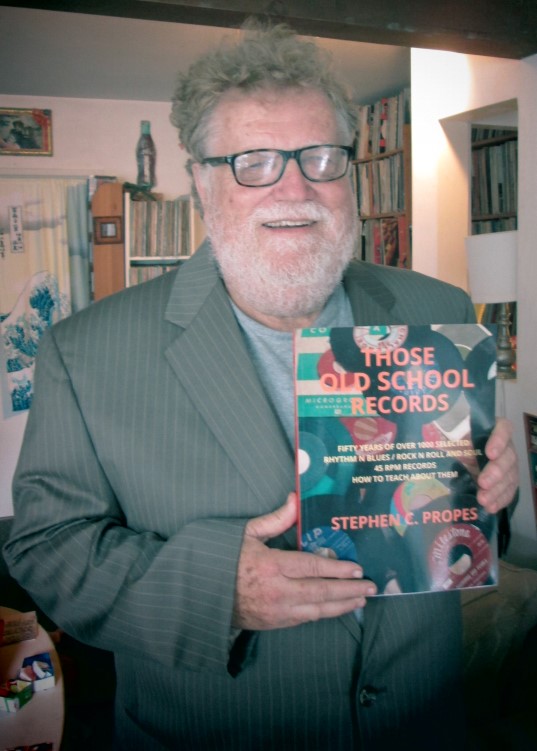 THOSE OLD SCHOOL RECORDS *In his book entitled Those Old School Records (378 pages, incl. index; A4-size), the author Stephen C. Propes advises us “to read a passage from this book and play the corresponding youtube video”, in case you’re teaching a class in rock and roll history. It may take a while, though, to go through the whole book, because the subtitle already reveals the amount of material you’re dealing with: Fifty Years of Over 1000 Selected Rhythm n Blues / Rock and Soul 45 RPM Records – how to teach about them. Stephen is a distinguished music historian, and I believe this is his 10th reference book in rhythm & blues and rock n roll flavoured oldies music. The preceding one called simply Old School was published a little over four years ago (http://www.soulexpress.net/deep2_2014.htm#oldschool). This time Stephen covers the years 1946 – 1987, starting from Arthur Big Boy Crudup’s That’s All Right and finishing with Los Lobos’ La Bamba. True to the title of the book, he’s in no hurry with the years and still on page 300 he’s going through the records released in 1965 and only on page 354 he enters the 1970s. That suits me fine. Not only the name of the artist, the title of the record, the label and the year of release, Stephen also tells us where the artist was born, where the single was recorded, who’s the original performer, who has done remakes and even suggests pairings, such as the Isley Brothers’ Twist and Shout to the Contours’ Do You Love Me. Some of the other suggestions include Hank Ballard & the Midnighters’ The Twist to Clyde McPhatter and the Drifters’ What’cha Gonna Do, Bing Crosby’s Please to the Beatles’ Please Please Me, the Miracles’ My Mama Done Told Me (1958) to the Miracles’ Shop Around and the Bailey Gospel Singers’ I’ve Got a Saviour (Across Town) (1951) to Ray Charles’ I’ve Got a Woman etc. etc. The best part in each case, however, is the description of the music itself and the stories about the artists and the making of that particular record. They are often told by the artists themselves – e.g. there are unique quotes from Big Joe Turner out of past interviews - and also by fellow artists, composers, musicians, label owners or just somebody involved in the recording process. On these pages we learn how Bill Haley & the Comets’ cover of Sonny Dae & the Knight’s Rock Around the Clock was first classified as “fox trot”, how the Four Tops/Aims first appeared on Dolores Carroll’s single in 1955 and how the Jordan Brothers released the original Gimme Some Lovin’ prior to the Spencer Davis Group. Did you know that Danny Taylor is probably the real writer of Fever, that the Monotones’ Book of Love is based on the Pepsodent jingle, that Johnny Rivers started his recording career under his real name of John Ramistella on Suede in 1958 and similarly Phil Spector used his middle name, when as Phil Harvey he released a jazzy single on Imperial in early 1959? Phil was the producer of the original version of Twist and Shout for the Top Notes, but when Bert Berns was cutting the hit version for the hard-headed Isley Brothers they were actually fighting in the studio. Also The Whispers twins – Walter and Wallace - who had first sung with the Utopians on Imperial in 1962, didn’t actually get along with each other during their early Dore sessions in 1965. There are dozens and dozens of such interesting details and stories in the book. Some have been chronicled earlier, but at least for me there was a lot of new info. Stephen has chosen many of the ground-breaking and significant sides mostly in the rhythm & blues genre, and – besides r&b, rock and soul - the styles of these selected singles vary from doo wop, blues, country and rockabilly to pop, zydeco, surf, swamp and occasionally novelty. Towards the end in the afterglow of British invasion understandably more and more such genres as garage rock, psych rock and retro-rock pop up... and in the case of the Drifters’ Moonlight Bay (already in 1958) – barbershop ensemble singing. SPINNING AROUND AGAIN *The second essential book is Spinning Around/A History of the Soul LP, volume 2: L-Z (ISBN 978-1-5272-2303-5; 434 pages, 12 with colour photos of LP covers; A4-size), written by John Lias. You’ll find the photo of the author in my review of the first volume at http://www.soulexpress.net/deep3_2016.htm#johnlias, and there you can also read about the history of these volumes, how they are compiled and about John’s criteria in choosing and presenting the material. Altogether it makes almost 1700 artists and over 6000 LPs. What amazed me was to read in John’s preface that “the vast majority of the books I have sold today have gone to addresses in England.” That excludes the rest of the U.K., Europe, the U.S., Japan and other territories. What’s the matter with you soul music fans all over the world? This is a priceless and well-researched piece of work, actually in a way a reference book on the history of soul music. If you consider yourself a soul music devotee, I urge you to order both of these volumes right away at john.lias@googlemail.com. After getting my hands on this volume, I immediately started checking on some of my idols, such as Oscar Toney Jr., the O’Jays, the Spinners, Esther Phillips, Bettye LaVette, Freddie Scott, David Sea, Tommy Tate, the Masqueraders, Latimore, the Manhattans, O.V. Wright... and yes, they are all there and presented as detailed and correctly as John only can. Only O.C. Smith seems to be missing. Again there are many artists featured that I’ve never heard of, or have just forgotten about them. Besides numerous self-contained funk bands, there are such Hawaiian acts as Lemuria and Lil’ Albert. How many of you are aware of Loncie Malloy, Marlboros, Maurice, Mr. Cix, Moonpie, Sapphire and Target, just to name a few more obscure names? I really enjoyed reading this book. John’s enthusiasm and dedication to this matter shines on every page, and it’s a pity that the English alphabet consists of only 26 letters, which deprives us of volume three. 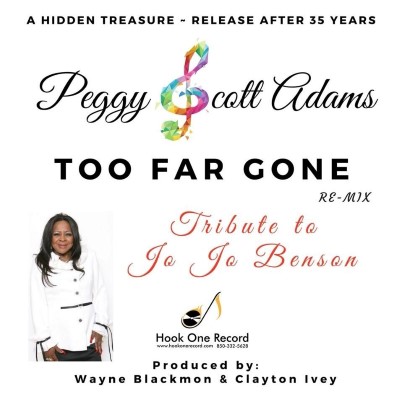 PEGGY SCOTT ADAMS *I briefly talked to Peggy, when her Life after Bill CD was released six years ago, but our more profound conversation, including looking back on her career, took place already eight years ago: http://www.soulexpress.net/deep210.htm#peggyscott. Too Far Gone (www.hookonerecord.com) – Tribute to Jo Jo Benson - reintroduces us to the almost forgotten Nothing Can Stand in Our Way LP by Peggy and Jo Jo, released in 1984 on GCS Records. Peggy goes back to those days 35 years ago: “Wayne Blackmon approached me about the possibility of Jo Jo and myself going back in the studio and recording together. At the time, it had been almost 10 years since Jo Jo and I have worked together. However, immediately the first day back in the studio we felt the magic – we felt nothing can stand in our way.” Wayne was one of the producers on the original album, too. “Wayne was involved, along with Clayton Ivey, Alan Schulman, and Billy Lawson. That all took place at Wishbone Studio in Muscle Shoals, Alabama.”  Too Far Gone was released in April this year on Hook One Record out of Pensacola, Florida. “It’s a new label, a joint effort (with Wayne)... just having fun – no pressures, and just maybe we can help some younger artists along the way.” From the original 1984 album they left out two songs, Nothing Can Stand in Our Way and Oh What a Feeling. “I love those songs and tracks. I am hoping to use them on another project in the near future.” They were replaced by Peggy’s version of Bettye Swann’s Make Me Yours, which first appeared on the Life after Bill CD in 2012, and a new song from last year, a swaying slow number called I’m in Love by Myself, produced by Peggy and Dee Bradley. Too Far Gone, a soulful cheating ballad written by Frank Johnson and Clayton Ivey, backed with a routine disco dancer named We’ll Make It, was released as a single off the LP in 1984. “The single did really well in the very small areas where it was marketed. This album never had national/international distribution, so it was never really given a chance. That’s why today I feel it’s a true hidden secret and a great tribute to the late great Jo Jo Benson.” Jo Jo passed away in 2014. Along with two quite poppy songs, co-written by bassist Brandon Barnes – Love Is What You Make It and Before the Fire Dies – and one melodic ballad titled Long Way Home from Here, there are still two truly beautiful songs from the pen of Phillip Mitchell that he and Mel & Tim first recorded 45 years ago – Same Folks and Oh How I Love You. Peggy: “At this time of my life it’s called grace. I don’t know what the future holds, but I know who holds the future. Hopefully I will continue recording not only myself, but with the development of new younger artists. I cannot express my sincere appreciation for all those, who along the way have helped me survive this 50-year career.” 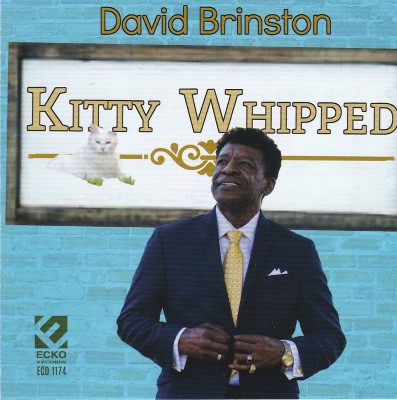 DAVID BRINSTONKitty Whipped (ECD 1174; www.eckorecords.com) is David’s sophomore comeback release on Ecko Records and he also pre-produced the tracks, while John Ward is the natural main producer on the set. David also wrote or co-wrote eight songs out of the ten on display. The most enjoyable and memorable dancers this time include John’s Kitty Whipped and David’s Sexy and You Know It and Buckle Up. You may have a hunch, which are the matters David praises on two mid-tempo tracks named Nothing like Good Sex and Club Booty. I’m Taking a Stand is the only romantic ballad, which makes this a good-time, party music CD. © Heikki Suosalo Back to Deep Soul Main Page Back to our home page |
