DEEP #2/2026 (July)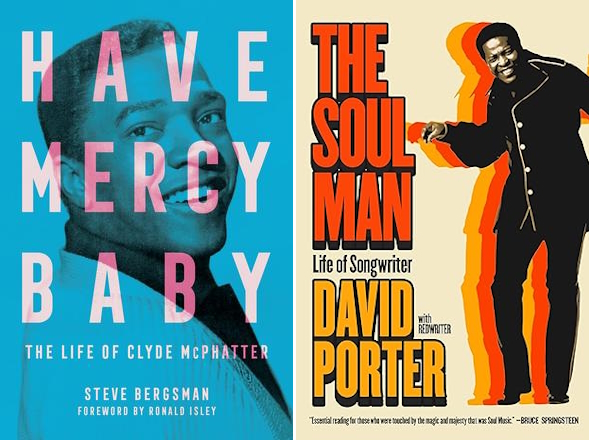
This article is dedicated to two new books, Steve Bergsman’s biography
on Clyde McPhatter and David Porter’s autobiography.
If your father is a minister, you love to sing, and you have a distinctive, beautiful voice, your fate is sealed—your first public performance will be singing in a church choir. In fact, it’s impossible to avoid. This was true for Clyde Lensley McPhatter, born in Durham, North Carolina, on November 15, 1932. At the age of five, he joined the Mount Calvary Baptist Church choir along with his brothers and sisters. After the family moved to Harlem, New York City, in the mid-1940s, he continued singing for the Lord by joining a gospel quartet called the Mount Lebanon Singers. Steve Bergsman’s book, Have Mercy Baby – The Life of Clyde McPhatter, was published in February 2026 by the University Press of Mississippi. The 276-page book (including 14 pages of black-and-white photos) offers 15 chapters, a detailed index, a selected discography, and a foreword by Ronald Isley. The ISBN is 9781496861283 (paperback). Bergsman is an experienced author with previous music-related works including What a Difference a Day Makes about black female artists in the 1950s, Earth Angels focused on Jesse Belvin, Guitar Slim, and Johnny Ace, and he co-authored All I Want Is Loving You: Popular Female Singers of the 1950s with Carol Connors. He has also penned books on Screamin’ Jay Hawkins, Billy Preston, Mary Wells, and, with Rosa Hawkins, Chapel of Love about the Dixie Cups. In total, he has written eighteen books covering music, travel, memoirs, and business, along with numerous newspaper articles. According to Bergsman, the research for the book relies on music trade publications, newspapers, magazines, music history books, biographies, and digital news stories. A key source was Clyde’s daughter, Deborah McPhatter, along with interviews with 28 other people connected to the subject. Some interviewees, like Hank Ballard and Frankie Ford, were interviewed as early as the 1980s. THE DOMINOES AND THE DRIFTERS Clyde’s secular music career began in 1950 as the lead singer of Billy Ward’s group, the Dominoes. His first single was a pleading rhythm & blues ballad, Do Something for Me, followed by hits like Have Mercy Baby, The Bells, and These Foolish Things Remind Me of You. However, the group’s biggest hit, Sixty Minute Man, featured Billy Brown as the lead vocalist. Clyde left the Dominoes in 1953 after 2½ years, primarily due to Billy Ward’s domineering behavior. Ward paid poorly, renamed the group to Billy Ward and the Dominoes, and credited Clyde not as himself but as Clyde Ward. Jackie Wilson replaced Clyde as lead singer. Bergsman covers this period extensively as well as all of Clyde’s later episodes. He scrutinizes contemporary publications, comments from those present, and articles by experts like Marv Goldberg. Each record is described in detail, with comparisons to other artists, chart histories, and context about the music genre at the time. Bergsman also examines conflicting information to uncover the truth. For instance, the book discusses not only the Dominoes but also figures like Ralph Bass and King/Federal Records. Occasionally, the focus broadens, such as a detailed discussion about gay artists near the book’s end. In 1953, Clyde and his new group, the Drifters, signed with Atlantic Records. They released hits like Money Honey, Such a Night, Honey Love, White Christmas, and What’cha Gonna Do, a melody later used for The Twist. 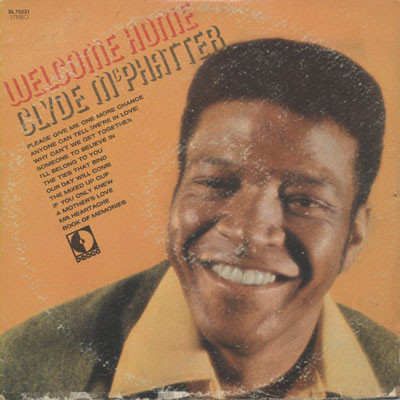
SOLO CAREER After completing his military service in 1956, Clyde was no longer the tenor lead of the Drifters. He had gone solo, recording the hit duet Love Has Joined Us Together with Ruth Brown in 1955 (Lorraine Lowe is Deborah McPhatter’s mother). The 1950s saw Clyde enjoy numerous big hits. He was among Atlantic Records’ most popular artists with songs like Seven Days, Treasure of Love, Without Love, Long Lonely Nights, and A Lover’s Question, which went gold. At his peak, he headlined sold-out shows and topped popular polls. Clyde’s decline began in the early 1960s and worsened towards the decade’s end. After brief stints with MGM (1959-60) and Atlantic again in 1960, he spent several years on Mercury Records (1960-65), where Ta Ta was his last big hit in 1960. Later labels included Amy (1965-67), Deram (1968), B&C (1969), and Decca (1970), where he recorded the lovely farewell album Welcome Home. His increasing alcohol use affected his personality and reliability, making him temperamental and causing him to miss shows. His dependency on prescription drugs and alcohol worsened during his time in London from 1967 until his deportation to the USA in late 1969. Clyde passed away in New York on June 13, 1972. Bergsman describes all these phases in a detailed, almost literary manner. He explores not only the music but also Clyde’s complex relationships with women. Clyde was married three times with no children but fathered two children with other women. His possible bisexuality is also discussed. For devoted fans, the book offers comprehensive research rather than new revelations, inspiring a renewed appreciation for Clyde’s powerful music. 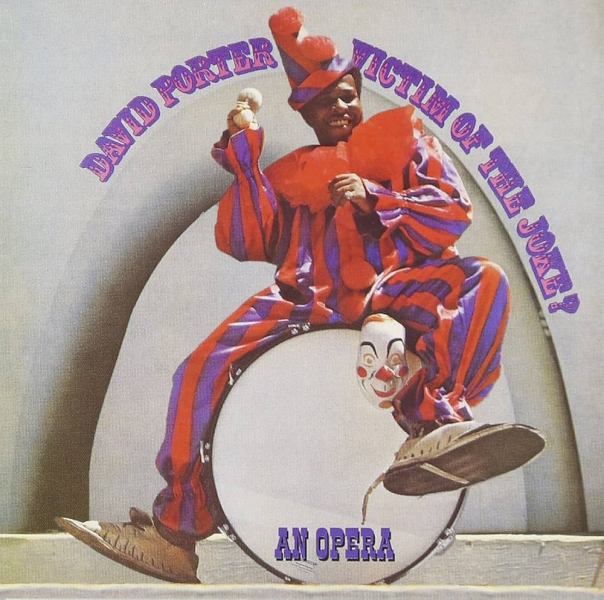
The Soul Man – Life of Songwriter David Porter (396 pages, 25 black-and-white photos) was published in April 2026, and it contains 28 chapters, an introduction by Jimmy Jam, and a foreword by Booker T. Jones. Unfortunately, there is no index or discography of any kind. David was born on November 21, 1941. After he lost his father at the age of two, he lived in Memphis with his mother and eight brothers and three sisters. Later, the number of brothers and sisters would still increase by one and one. At the age of seven or eight, David joined the Rose Hill Baptist Church choir with one Maurice White, and they also took part in local talent shows along with such future deep-soul heroes as Spencer Wiggins and Don Bryant. The WDIA radio station trained them in the right kind of music. The first singing group David joined while still at Booker T. Washington was called the Marquettes. That was short-lived, but the next group, called the Four Stars, was more heavy-weight. Percy Wiggins: “It was a rhythm & blues group and it consisted of Spencer Wiggins, myself, David Porter and Tyrone Smith.” As a solo artist, David’s first single on Eagle Records was released in December 1961, right after he had turned twenty. Chivalry is a poppy toe-tapper, while Farewell is a heartbreak teen ballad. David wrote both sides. The second single, eleven months later, appeared on Hi Records under the stage name of Kenny Cain. The self-written Words Can Never Say is a fast ditty, and the flip, Practice Makes Perfect (written by Willie Mitchell-Joe Hall-David Porter), is a similar poppy song. David’s third and fourth singles were recorded on April 15, 1963, and released on Savoy under the name of Little David—his stage name when working in white clubs after high school. Of those four songs, the driving rhythm & blues belter spiced with a choir and horn section, titled Home Is Where You Come, is the most compelling one. However, none of those singles made any waves. Already in 1961, right after LeMoyne College, David auditioned for Jim Stewart at Stax - but failed. Three years later, however, he became the first staff songwriter at Stax, first on a six-month trial. On that earlier audition, David had William Bell as one of his background vocalists. William reminisces about how, alongside his Del-Rios, the Satellite recording group, the Veltones were highly popular in the Memphis area in the late 50s, and Isaac Hayes’ Teen Tones and David Porter’s Marquettes were tough rivals, too. William Bell: “We all knew each other. We were good friends. I knew David from many years. Isaac went to a different school, but I knew him.” WITH ISAAC In the early 1960s, David, with his Marquettes and Isaac in the Teen Tones, competed at the Palace Theatre on Wednesday nights, but eventually those two singers teamed up. At that point David worked also as an insurance salesman and tried to do business with Isaac. Their first concrete business collaboration in 1964 was a recording company called Genie. The first single on that label was Homer Banks’ soulful ballad, Lady of Stone, written by David and Isaac. It was cut at Chips Moman’s American Studios, and Chips was also a partner in Genie, which eventually lasted only for three singles. In the mid-60s, David brought a lot of talent to Stax. Alongside Isaac, he introduced Booker T. Jones, Andrew Love, Wayne Jackson, and Bettye Crutcher. Bettye: “I set an appointment at Stax, and David Porter auditioned. He said 'are you sure you're not already signed with anybody', and I said 'no'. They had this guy there, and his name was Raymond Moore, and David said to him 'we've been trying to get you to write like this for a year' (laughing). My songs at the time were very sweet and pretty, because the artists I listened to most were Nancy Wilson, Dionne Warwick, and I loved Sam Cooke. David said 'I really like the way your songs are structured, but you're gonna have to write songs that work for our artists here at Stax. Well, he shouldn't have told me that (laughing), because I went and wrote a song for Johnnie Taylor. They had been looking for songs for him, but nobody could come up with anything that really suited him or his style… so I wrote this song, Somebody's Sleeping in My Bed” (in '67). Bettye, Homer Banks, and Raymond Moore formed a writing team called We Three. David’s first solo single on Stax was released in January 1965. Written by Porter and Lee - aka Isaac Hayes - Can’t See You When I Want To is a pleading, soulful ballad. Backed with a big-voiced stomper titled Win You Over, commercial success still kept eluding David. SAM & DAVE Atlantic Records’ Jerry Wexler brought Sam & Dave to Stax, and David volunteered to produce them. David and Isaac joined forces, and already the duo’s second Stax single, You Don’t Know Like I Know, turned into an R&B hit (#7) in the early 1966. Within the next three years, such smashes as Hold On! I’m A Comin’ (#1), When Something Is Wrong with My Baby (#2), Soul Man (#1), and I Thank You (#4) would follow. In this book, David thoroughly analyses Sam & Dave’s hits, as well as the sound of Porter & Hayes. “We were looking for something that nobody was doing yet.” He said to Isaac that “we have to bring about a feel to our music that has the same energy as the church […] not only in an inspirational way but in an emotional way as well.” Besides Sam & Dave, some of the other artists that the duo often worked with included Carla Thomas (B-A-B-Y in ’66) and the Soul Children (The Sweeter He Is in ’69). J. Blackfoot reminisces: “I knew of David Porter. There was a liquor store on McLemore. We were behind it. We were drinking wine, and everybody was listening to me sing. We all tried to harmonize. David walked from Stax, across the street. He was getting some liquor to take back to Stax. The guys stopped him and said ‘you got to hear this guy’. So, we went to a café across the street – they were calling it ‘the juke joint café’ – and I put a quarter in a juke-box for two records, I’m in Love and Shout Bamalama, a song written by Otis Redding. David said ‘hey man, I want you to come by Stax. I want people to hear you’. That’s what I did. I went by there. Allen Jones played piano and tried to see could I follow him.” Norman West, Anita Louis, and Shelbra Bennett rounded up the Soul Children, whose remarkable recording career was launched in 1968 – thanks to David and Isaac. David lists Al Jackson Jr., Steve Cropper, Duck Dunn, Booker T. Jones, Isaac Hayes, and himself as Stax’s core members in the mid- and to a degree latter part of the 60s. Those six “established the foundation.” Some significant incidents took place a bit later in the history of the company: Al Bell was appointed Vice President, and Stax was sold to Gulf & Western, but according to David there was no division within the company. Stax remained a harmonious corporate body. In those days, David would perform with Isaac in clubs, and for security they had two persons, Johnny Baylor and Dino Woodard, known as “Mr. Boom Boom.” Dino: “I eventually went to Stax Records with Johnny Baylor around his second trip down there. I did the promotion on most of his records. I went to radio stations throughout the country and that was the same time I was doing promotion for Stax Records and all their artists, together with KoKo Records. Isaac Hayes’ first album – I was the one that really pushed that up to New York City and around the country. I was running with that.” GRITTY, GROOVY & GETTING’ IT Isaac struck gold with his second album, Hot Buttered Soul, in 1969, and one year later David entered the charts (#4 soul; #163 pop) with his first album, Gritty, Groovy & Getting’ it, on Stax’s subsidiary Enterprise, produced and co-arranged by Isaac. David’s and Isaac’s emotional ballad Can’t See You When I Want to is the first single taken from the album and also David’s first record to hit Billboard’s single charts (#29 soul; #105 pop). Two years later, a duet with Isaac on an old Stax song named Ain’t That Loving You (For More Reasons Than One) was his second and last entry. David released three more albums on Enterprise: David Porter…Into a Real Thing (1970; #9), Victim of a Joke? An Opera (1971; #46), and Sweat and Love (1973; #50). He remained engaged in A&R/Talent, in artistic creation. He was appointed Vice President of the Volt subsidiary, but soon the whole corporate group had to close its doors due to intrigues by banks and the CBS company. After the bankruptcy, David presented the Stax material for sale and ended up heading the Stax Fantasy offices in Memphis in 1977. He left after two years, when it dawned on him that Fantasy only wanted to sell off the catalogue and was not interested in any new material. In the 1980s and in the decades after that, David continued making music with his old friend Maurice White, as well as Lou Rawls and many other artists. With Garry Coin, he wrote over 200 songs, and some of them are featured on the compilation album titled Chapter 1 – Back in the Day (2022). On lead vocals you can hear Brandon Wattz, Candise Marshall, Marcus Scott, and some of the other maestros that were involved in this project include Lester Snell, Willie Hall and Kirk Smothers. Isaac passed away in 2008, and Maurice died of Parkinson’s disease in 2016. David remained active. In 2012, he created The Consortium MMT (https://www.theconsortiummmt.org) to develop young talent and give them opportunities. In 2015, he and Tony Alexander launched Made in Memphis Entertainment (MIME; https://www.mimecorp.com/),a consortium that includes a recording studio, a distribution company, and a publishing company. In his book, David writes openly also about his personal life—like his first marriage in the early 1960s, which produced three children; his second marriage, which lasted six years in the 1970s; and his third one, which persisted for close to thirty years; and most importantly Kontji, “the love of my life”. The book is an easy read and exposes many interesting twists and turns, but there were a few inconsistencies that I would have loved to clear up. Unfortunately, the author wasn’t available for an interview. © Heikki Suosalo Back to Deep Soul Main Page Back to our home page |
