DEEP # 5/2014 (October)There was one particular question I wanted to ask L.C. Cooke, and I did get the answer. You can read it below in my feature on Mr. Cooke and his whole career. In the retro-soul section a lot of Louisiana music is reviewed this time, but nevertheless I decided to call Mr. Harold Thomas of the Masqueraders in Memphis and talk about the recent re-release of their very first album. Content and quick links:Interviews:L.C. Cooke Harold Thomas of the Masqueraders New CD release, CD reissue & compilation reviews: L.C. Cooke: The Complete SAR Records Recordings Gladys Knight: Where My Heart Belongs Bloodstone: Fly Away Roy C: Give Me a Chance The Masqueraders: Everybody Wanna Live On Various Artists: Cracking the Cosimo Code/60s New Orleans R&B and Soul Various Artists: Ain’t It the Truth/the Ric & Ron Story, vol.2 Various Artists: Boppin’ by the Bayou/Made in the Shade Various Artists: Brent Cold, Cold Heart/Where Country Meets Soul, vol. 3 Book Reviews: Graham Betts: Motown Encyclopedia 
INTRODUCING... L.C. COOKE*L.C. was born to the Reverend Charles Cook, Sr. and Annie May Cook in Clarksdale, Mississippi, on December the 14th in 1932, so soon he’ll turn 82. “Altogether there were eight of us, and I was the sixth. I was born in December and we moved to Chicago in February, where I’ve lived all my life.” One of his older brothers, Samuel Cook, was born almost two years earlier, on January 22 in 1931. L.C. isn’t a very common first name. “Back then they had midwives. You don’t go to the hospital, but a lady helps you to deliver the baby. My mother wanted to name me Alec. Midwife couldn’t spell Alec, and she just wrote L.C. Of course, I’m glad she did, because Alec didn’t fit me.” L.C.’s second marriage has lasted long, to say the least. “Our anniversary was in September – 45 years! And we knew each other seven years, before we got married, so that makes it 52 years.” THE NOBLEAIRSL.C.’s first stab at music was singing Christian songs with the Singing Children. “That was my family group. There were two of my sisters, Hattie and Mary, my brother Charles - he was the lead singer – Sam, who was the tenor singer, and I was the bass singer. I was five years old, when we started, and we sang together for about three or four years.” “Then I formed my own group, the Nobleairs. Sam gave us the name. That was the late 40s, and we stayed together for about five years. I was the lead singer. My tenor singer was Andrew Henderson. Then I had a bass singer named Johnny C. Hall. My baritone singer was Johnny Carter, who went with the Flamingos and the Dells later on. That was his first quartet.” Sam gave that name probably because L.C. – and Johnny Carter as well – were members of the local “street club” in Chicago called the Nobles. 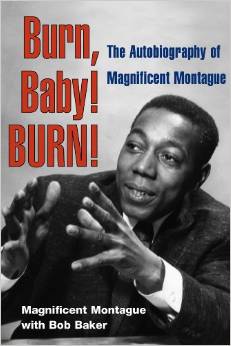
THE MAGNIFICENTS“After the army (1952-54) I sang with a gospel group – no recordings – but I quit them and joined the Magnificents.” L.C. joined the group right after it had enjoyed its only charted hit with the debut single, Up on the Mountain, on Vee-Jay in 1956 (# 9 on Billboard’s rhythm & blues charts). L.C. replaced Thurman “Ray” Ramsay. You can read more about this doowop group in Marv Goldberg’s fine article at http://www.uncamarvy.com/Magnificents/magnificents.html. L.C. and the Magnificents found each other in the summer of 1956 through Nathaniel “Magnificent” Montague, a charismatic disc-jockey and radio personality. In his book Burn, Baby! BURN! (Montague with Bob Baker; ISBN 0-252-02873-2; University of Illinois Press) Nathaniel writes that Sam “had a younger brother, L.C., with a great word-of-mouth reputation forged from singing with every gospel group that passed through Chicago. L.C. had never been recorded... Not only did L.C. have the Cooke gift of song, but he was a powerful songwriter.” L.C.: “Magnificent Montague came by my house and asked me, if he could see my mother and father. So he went upstairs – we lived on the fourth floor – and my father told him that, if I wanted it, it would be alright. That’s how I got with the Magnificents.” At that point the line-up of the group was Johnny Keys (1st tenor), Fred Rakestraw (tenor), Willie Myles (bass) and Barbara Arrington. “I still talk to Johnny Keyes all the time. We’ve remained good friends. He’s got a little Alzheimer’s, but he’s doing good.” The first-ever record that L.C.’s voice is on is the Magnificents’ second single, Caddy Bo/Hiccup (Vee-Jay 208), which was cut in July 1956. Barbara is leading, both on the fast and joyous A-side, and the slightly slower flip. The single went nowhere, and the third release – the quick-tempo Off the Mountain b/w the wistful, waltz-time Lost Lover – was released in January 1957 on Vee-Jay 235, but it didn’t do any better either. Soon after that L.C., Barbara and Willie left the group. L.C.: “I left to have a career as a solo singer.” Magnificent Montague: “I had no illusions about the group going far. They were one-hit wonders riding my coattails; talent-wise, none of ‘em could hold a candle to L.C.’s pent-up, harshly beautiful voice... I gradually lost interest and began producing L.C. as a solo artist on Chess.” One more interesting detail from April 1957: L.C. played drums on his brother’s last recording session with the Soul Stirrers. CHECKERL.C.’s first solo single – as L.C. Cook - on Checker 903 came out in the summer of 1958, and here his old group, the Magnificents, is singing on the background. Reggie Gordon had replaced L.C. in the group. Do You Remember is a slow, pretty song – not unlike what Sam put out on Keen those days - while the flip, Blue Tears, is a fast doowop number with a sax break in the middle. Writer credits on both sides go to L.C. and R. Catalon. “That’s Magnificent Montague, but I did all the writing. He just put his name on there.” Rose Catalon is Nathaniel Montague’s wife. The follow-up on Checker 925 was recorded around the same time but released only a year later, and again L.C. is backed by the Magnificents. Please Think of Me is a “rockballad” – as they used to define it those days – whereas I’m Falling again is a fast dancer with ‘ding-dong’ effects. “How I thought of that sound? I was in a telephone booth and the telephone’s ringing. I wrote that song in a telephone booth.” The third and final Checker single (935) was again written by L.C. and produced by him together with Magnificent Montague. Released in 1959, If I Could Only Hear is an uptempo, melodic pop song, and also L.C.’s own favourite. No! I’ll Never on the flip is a tender love ballad. “Everything I did, I did in a pop style. I did it for a reason. I designed all my songs to be pop to go more white, rather than black. I wanted to get to the white audience.” In 1960 L.C. and the Magnificents still backed up Bo Diddley on two of his singles, Road Runner (Checker 942) and Walkin’ and Talkin’ (951). “Bo Diddley liked our sound, and he asked us to record with him, and that’s what we did.” 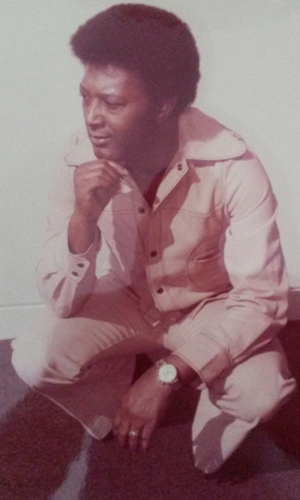
SARIn 1959 Sam Cooke released the first single on his own SAR Records. The name stands for Sam(uel), J.W. Alexander and Roy (S.R. Crain). The label folded soon after Sam’s death in December 1964 - after 57 singles and 4 albums. Sam and James W. Alexander worked a lot together in creating music and making it a business for themselves in the 50s and 60s, and Roy Crain, apart from being a founder of the Soul Stirrers in the 20s, worked also as Sam’s road manager. SAR’s roster included, among others, the Soul Stirrers, Johnnie Morisette, Johnnie Taylor, the Sim(m)s Twins, the Womack Brothers -> the Valentinos, Linda Carr and the 16-years-old Jacki Ross. 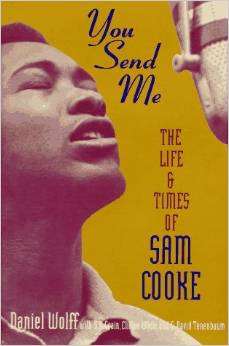
In his book, You Send Me/The Life and Times of Sam Cooke (ISBN 1 85227 5111 1), Daniel Wolff writes that “Sam understood that the industry saw artists as disposable: ‘pains in the asses’, as Roulette’s Mo Levy put it. There were examples of Negroes owning labels – John Dolphin and Dootsie Williams in L.A., Berry Gordy and his still hitless Tamla/Motown in Detroit – but no rock & roller of any color owned his or her own label.” L.C.: “I quit Chess and went with Sam, when he formed SAR.” L.C. recalls that “the first I did with Sam was Take Me for What I am”, but all the discographies show that his first released SAR single in late 1960 was a melodic teeny-pop ditty called Magic Words, coupled with the fast and almost inspirational Teach Me. Produced by Sam, he also co-wrote both songs with J.W. Alexander (SAR 109). On the follow-up (SAR 112) in early 1961 the name of the artist is now for the first time spelled L.C. Cooke, instead of L.C. Cook. Sweetened with strings, Sam’s swaying pop song called The Lover is flipped with L.C.’s own melodic, uptempo number named Sufferin’. “It’s one of my favourites.” The third single – SAR 134 in 1962 – consists of L.C.’s fast and easy rolling Tell Me and Sam’s mid-tempo, hooky You’re Working out Your Bag. SAR 141 in 1963 pairs Sam’s candidate for a new dance titled The Wobble and Sam’s and J.W.’s hurried pop number called Chalk Line. L.C.’s final release on SAR (148) in early 1964 introduced two more of Sam’s tunes, the mid-tempo and laid-back Put Me down Easy – “a beautiful song” – and a catchy and poppy dancer named Take Me for What I Am. There were plans for L.C.’s sixth SAR single, but Sam’s novelty number, Missy Sally (close to the Little Richard territory), backed with his slowly swaying soul song titled Gonna Have a Good Time, were left in the can. “That’s when Sam passed. His passing affected me very deeply. He was my brother. He wasn’t much older than me. We were very close. We were the closest in the family.” 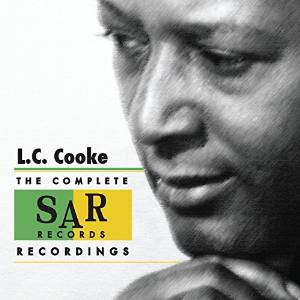
THE COMPLETE SAR RECORDINGSBesides that one single, there were also plans for L.C.’s SAR album, and now – with the delay of only fifty years – the product finally hits the streets, L.C. Cooke/The Complete SAR Records Recordings (Ace/ABKCO, CDCHM 1412; www.acerecords.com; essay by Peter Guralnick). In addition to all the SAR recordings above, it also reintroduces two of those late 50s Checker sides, I’m Falling and If I Could Only Hear. “I love the CD; first of all, because me and Sam wrote all those songs. I wrote almost as many as Sam.” Among the musicians you can spot such names as Clifton White, Rene Hall, Bobby Gibbons, Bobby and Cecil Womack on guitar; Chuck Hamilton, Cliff Hils and Chuck Badie on bass; Earl Palmer and Sharky Hall on drums; Eddie Kendrix and Billy Preston on organ and Bill Green, Harold Battiste and Red Tyler on sax. As a bonus, the CD also offers one side of L.C,’s next single in 1965 on Montague’s label called Destination (601). Produced and written by L.C. and Montague and recorded at Universal in Chicago, Do You Wanna Dance (Yea Man) kicks off with “a sermon” and proceeds to a laid-back, mid-to-uptempo number. On the B-side there’s a light mid-pacer called I’ll Wait for You. “On the back of both of them my brother sings, and Major Lance’s sister and Reggie Gordon (ex-Magnificent) is on the background – but no Johnny Keyes and no Hawkins Brothers.” As Magnificent Montague stated earlier, L.C. is also a prolific writer. Besides many of his own recordings, he has penned for others such songs as Happy in Love, I Dreamed a Dream, I Need You Now, I Need Your Love – a fast pop & doowop number that he cut with the Magnificents – In Your Spare Time Please Think of Me and the slow Once in a While aka Please Answer Me for Aretha Franklin. “I was in Atlanta, Georgia, and I had just come out of the shower. I had a towel wrapped around me, when Aretha knocks on the door. I was singing this song. I was on my way to California to record it. She said ‘give me that song’. I said ‘no, I’m getting ready to record it’. She sat on my bed and cried and begged me until I gave her that song.” Produced and arranged by Bobby Scott, Aretha cut the song for Columbia in 1963. BLUE ROCKL.C.’s first released album was cut in Chicago in 1965 and it came out on the Blue Rock label under the title of L.C. COOKE SINGS THE GREAT YEARS OF SAM COOKE (MGB 24001). The eleven tracks are That’s Where It’s At / Win Your Love for Me / Bring It on Home to Me / Rome Wasn’t Built in a Day / Let the Good Times Roll / Cupid // You Send Me / Wonderful World / Twisting the Night Away / Love in My Heart / That’s Heaven to Me. The only single off the album was Wonderful World b/w That’s Where It’s At (Blue Rock 4030). “I felt good singing those songs, because I loved my brother.” No way they are blatant copies, but on the contrary L.C.’s original interpretations. “At the early stage in my career we sat down with Sam and we had a talk. First of all, my and Sam’s voice were so similar, so when we sang the same piece, I sounded like Sam. But I didn’t want to sing like Sam. I may sound like Sam, but I don’t SING like Sam.” The music on the album was arranged by Charles Hanley and Johnny Boyd, conducted by Al Smith and produced by Andre Williams. “Andre was a good friend of mine. I’ve been knowing him for years before we did the album. It was a project of love. I co-produced it together with Magnificent Montague and Andre, but Andre got all the credit. Andre was with Blue Rock and Mercury, and Montague wasn’t, so Andre wound up with all the credit.” 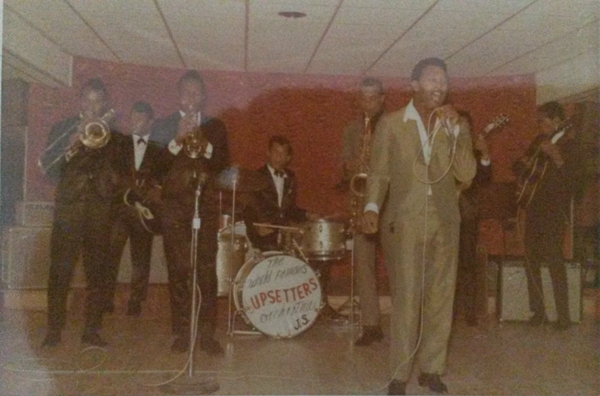
WANDL.C.’s final record was released on Wand (1171) in 1968. Produced by Chips Moman at the American Studios in Memphis, the single paired a semi-funky number called Half a Man and a poignant soul ballad entitled Let’s Do It Over. “Bobby Womack wrote Half a Man (with Darryl Carter). Let’s Do It Over was one of Joe Simon’s old songs, which I re-arranged and did it in a different way than Joe Simon.” The song was written by Dan Penn and Spooner Oldham and released by Joe in 1965 on Vee-Jay (# 13-r&b). Unfortunately, not any of L.C.’s records charted nationally those days. In the late 60s L.C. still toured with the Upsetters, which used to be first Little Richard’s and then Sam’s band. “I got Upsetters, because it was Sam’s band. When Sam got killed, they’d go with me. ‘Why don’t you come with us and be our head-liner’?” And here we come to the big question that I’ve been wanting to ask L.C. for a long time: why did he stop recording and performing altogether in the late 60s? “If I go to a record company, they knew I know the business. They knew that they were going to have to pay me, so they’d rather get somebody dumb that don’t know the business, so they can take all the money and take all the publishing. If I wrote a song, I want to get paid for writing. That’s why nobody wants to mess with me.” “Sam was a very bright businessman. There weren’t but two people at that time that had their own publishing and their own record company. That was Sam Cooke and Paul Anka. It wasn’t Elvis Presley or any of the others. Everything that Sam recorded for RCA Victor, after thirty years had to come back to Sam. He owned everything after thirty years. Sam could record anywhere and anytime he got ready. He didn’t have to wait for RCA Victor. If he got an idea, he could go into the studio and record what he wanted. He had a company named Tracey Limited. They did all the Sam’s records and gave them to RCA Victor.” With L.C. we both agree that Sam’s flourishing business and his skills and cleverness in that field must have partly caused his untimely death under mysterious circumstances at the Hacienda motel in Los Angeles in December 1964. “That WAS one of the reasons. Let’s face it, why would Sam rape somebody with all the money he had. In 1964 they could get away with anything they wanted, and they did!” That all happened almost fifty years ago, the same year L.C.’s first album was supposed to be released. Grab it now! Who knows, maybe you have to wait for another fifty years for its re-release. (Interview conducted on September 15, 2014; acknowledgements to Otis Clay, Stan Mosley and Velar Mayfield). 
GLADYS KNIGHTWhere My Heart Belongs (www.shadowmountainrecords.com) is the third inspirational solo set by the Empress of Soul, after Many Different Roads and One Voice, although the latter one was recorded together with the Saints Unified Voices. I must admit that – with the exception of a couple of songs – I wasn’t too crazy about Gladys’ preceding secular CD, Another Journey (www.soulexpress.net/deep1_2014.htm#gladys), but here we are heading back in the right direction. Produced by Gladys and Christine Fryer, there’s a live rhythm section on many of the tracks and a 10-piece GK Chorale, which at times sonically almost drown Gladys. In the choir you can spot such names as Alfie Silas-Durio and Merald “Bubba” Knight. The opener, Need You Love You, is a really beautiful love song, written by Gladys, Benjamin Winans and Stephan Moccio. On YouTube you can actually watch BeBe and Gladys do a duet on this ballad in 2011. Always, composed by Kirk Franklin, is a big and a lot louder ballad, boosted by GK Chorale, and it first came out on The Rebirth of Kirk Franklin album in 2002. Track number three, Just Look Up, is a similar big-voiced, downtempo song. The only uptempo track, Life, derives from the ’85 album by the same name and there it was written, produced and arranged by Gladys, Bubba and Sam Dees, and I must say that I prefer that almost thirty year old original to this quite computerized remake. Brandon Avery Smith is a young man, who used to be one of Gladys’ background singers, but now under the stage name of Avehre he’s creating a solo career of his own. On this CD he penned two songs for Gladys, the slow and (again) loud Immersed and the hypnotic Champions, set to an Indian beat. The other song that BeBe Winans co-wrote is a melodic, slow swayer called In the Midst of the Rain, and with its elegant orchestration and emotive vocal delivery it belongs to the top-three tunes on this set. BeBe originally cut it for his eponymous solo project in 1997. Here Gladys is backed by her own SUV (Saints Unified Voices) Choir. Recorded live at the University of Nevada-Las Vegas, the traditional Were You There is performed in a dramatic and massive way with a big orchestra and the SUV Choir. Alongside Need You Love You and In the Midst of the Rain it qualifies in the top-3. Since I’m not a fan of kiddie sound and children’s choirs usually turn me off, I’ll skip the rest two slow numbers - There Is a Green Hill Far Away and Jim Weatherly’s 2004 song, Happy Birthday Jesus bound together with Sweet Little Jesus Boy. For the most part Where My Heart Belongs offers heartfelt, traditional and in a way old-fashioned inspirational music – culminating in that delightful top-3. For soul music fans the rest of the repertoire, however, may sound too spiritual and churchy (www.gladysknight.com). 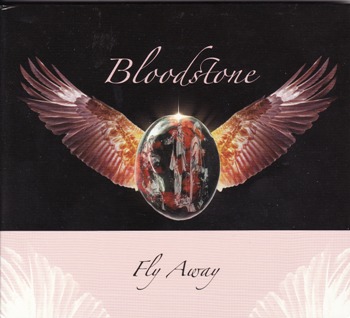
BLOODSTONEThis Kansas City group was actually founded over fifty years ago, way back in 1962. In the 70s and early 80s it scored many hits – Natural High, Never Let You Go, Outside Woman, My Little Lady, We Go a Long Way Back – and I believe that this latest CD, Fly Away, is their 17th album altogether. Their main man, Charles D. Love, passed away in March this year, but Charles McCormick (bass), Harry Williams (keyboards) and Donald Brown (guitar) – all on vocals, as well - carry on. The opener, Possible, is a hurried mid-tempo cut with fine harmonizing and slightly jazzy arrangement. Fly Away is an EW&F type of a dancer with a real horn section, whereas the upbeat Comfortable reflects Michael Jackson’s sound. It includes a rap by Femi. Spread Some Love is a convincing, swaying soul ballad with a social message – Femi again – and Hense Powell’s strings. Forever More is another quality ballad and the deepest on the set - romantic and soulful. Charles Love co-wrote both an “after hours”, moody love song titled No One, and a hypnotic slow “revenge” beater called I’m Gettin’ Even Wit Cha. Syl Johnson’s singing is the first thing that comes to your mind on two downtempo tracks, The Best of Two Worlds and Need It. Two awful autotune, vocoder - and whatever - tracks aside, we’re still left with two nice slowies, Let Me Be Me and a sort of ‘symphonic folk-soul’ piece – if such genre exists – named It’s Over Now. I believe that many classic soul music fans will like this CD. At least please give it a listen. 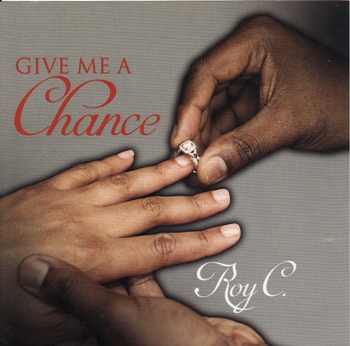
ROY CIn terms of continuity and consistency we can always rely on Roy C. Hammond. His latest CD, Give Me a Chance (Three Gems 137; www.roycmusic.com), once more offers both melodic, memorable and easily flowing mid-to-up-pacers and pleasant floaters, and those classy Roy C ballads, tender and pleading. The highlights in the first category are the title tune, the Caribbean I’m down Here in Jamaica and a catchy toe-tapper named If You Got a Good Woman. On the downtempo side there are the poignant I Wish You Could Have Been My Wife, the strong and soulful You Gonna Lose What You Got, the longing Do You Know How Much I Love You and the romantic Ain’t No Mountain We Can’t Climb. Roy wrote all eleven songs and co-arranged the music with Jonathan Burton. Six musicians are listed and again the programmed horns and strings create a rather strong sonic backdrop, except on the bluesy How Can You Do Me Wrong. It’s nice to know that some things still have that staying power. 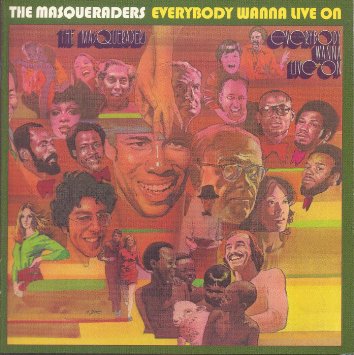
COMP-ART-mentTHE MASQUERADERS *As amazing as it seems, the first-ever album by the Masqueraders, whose history goes back to the late 50s, was released only in 1975. Everybody, who has seen the group perform, praises the voices, beauty of singing and great harmony, so in this case, if any, we are talking about truly Unsung. You can read the complete history with interviews and discography at http://www.soulexpress.net/masqueraders_story.htm. After that I still did a couple of updates (>http://www.soulexpress.net/masqueraders_update.htm). The album in question was entitled Everybody Wanna Live On, it was produced and arranged by Isaac Hayes and released originally on ABC (# 57 – soul). You can read the comments on the album and its history from the members of the group in the in-depth feature above, but in conjunction with its recent re-release (CDSXD 143; www.acerecords.com; notes by Tony Rounce) I decided to contact one member, Harold Thomas, to find out about today’s activities, too. Harold: “I think it was a great album. I just think that it got lost, because Isaac Hayes got caught up in that bankruptcy. I think that he was at the top of his game, when he chose to produce that album on us. He had received the award for Shaft and he had a lot of swag – as the young people call it – about him at that time. He had all the good musicians around him. We were writing all of our material, except Baby It’s You.” BABY, IT’S YOUThe old Shirelles ’62 hit was innovatively rearranged into a very slow and soulful jam. “We did a good job on it, turning it around. It really didn’t sound like the original song, but it turned out awesome, and Isaac liked it, too.” It was chosen as the first single off the album and it reached # 76-soul. Baby It’s You was backed with the uptempo Listen. “I came up with the idea for it together with the lady I was working with at the time. Her name was Eula Rivers. She started at Stax, too. She was kind of instrumental in getting us with Isaac. That was a good message for the people.” The music for the album was mainly orchestrated by Lester Snell. “Lester is still around. As a matter of fact, he arranged some stuff for Eddie Floyd. Tex and I are doing background on that.” Another member of the group, Robert Lee Wrightsil was called “Tex”, and Harold and Tex are backing Eddie on the Down by the Sea CD (New Generation Doo Wop Soul, in 2013), as well as on Eddie’s 2012 holiday album, I’ll Be Your Santa Claus (again on New Generation Doo Wop Soul). 
THE TRAVELING MANThe second single was one of the cream cuts, a classy ballad named (Call Me) The Traveling Man (# 32-soul, # 101-pop). “I love it. We got a committee here in Memphis called ‘The Memphis & Shelby County Music Commission’. They’re always trying to help the musicians around the area. They would have a listening party, and if you had any song that you wanted to get critiqued, just bring it over there. So I decided to take Traveling Man over there and played it. Man, they went crazy over the song. They didn’t know it was already out there.” The third single was another classy soul ballad called Your Sweet Love Is a Blessing. “That was almost like a gospel song. It had a spiritual undertone. We thought it was a great song. The whole album was great. I Ain’t Got to Love Nobody Else (in 1968) was our first big thing. Larry Uttal over at Bell had a couple of good promoters on that thing, and it was going up the Hot-100 like wild fire (# 7-r&b, # 57-pop). Chips Moman got excited about that. He jumped the gun and told Larry that he wanted to put our next single (I’m Just an Average Guy) on his AGP label. So if we’d had that kind of promotion on the album Everybody Wanna Live On, it would have blown out of the water.” Besides impressive slow songs, there were some solid uptempo numbers on the album, too, such as Everybody Wanna Live on and Sweet Sweetning. “They had a nice beat to them. We lean more towards the ballads, but we try to put some uptempo songs in there.” Unfortunately in Memphis there’s not a venue anymore, where you can go and enjoy live music by the Masqueraders. “I worked at the post office for awhile and then I retired, and now I’m back doing some security work. I got a bunch of gospel songs that I would love to put down. I just don’t have a sponsor yet.” “Tex and I and Sam (Hutchins), we worked a lot senior homes, nursing homes and retirement homes. The last thing we did in June 2012 in New Jersey was for Charles and Pamela Horner (www.classicurbanharmony.net). It was all five of us - Harold, Robert, Sam, Lee Hatim and David Sanders. David had Parkinson’s, but he came along anyway. Since then we haven’t done anything. Lee and David are in Dallas, and me, Tex and Sam are in Memphis. We all work, but if anything comes up it’s not a hard thing to get us together.” (Interview conducted on September 20, 2014). 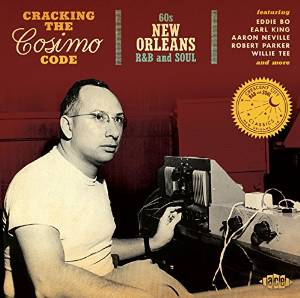
COSIMO CODEFrom Memphis we travel still down south, while Cracking the Cosimo Code/60s New Orleans R&B and Soul (Ace, CDTOP 1402; 24 tracks, 64 min.). Essays are written by John Broven and Red Kelly (www.souldetective.com), and track-by-track annotations by John Ridley (www.sirshambling.com). On this set the focus of attention is Cosimo Matassa, a studio and label owner & recording engineer, who passed away a little over month ago, on September 11th, at the age of 88. All these songs were cut at his Cosimo Recording Studios between 1960 and ’68, and they were released on such labels as Minit, Ric, Imperial, Instant, Jamie, Frisco, Amy, Nola, Hot Line and Deesu etc. The main producers were Allen Toussaint, Harold Battiste, Dave Bartholomew, Wardell Quezergue and Huey Meaux. This CD also celebrates the recent launching of a new website, http://cosimocode.com, where all Cosimo recordings since 1960 are listed with a lot of info: history, description or a sound clip, photo, label #, artist, the year etc. Some of the contributors include Ray Topping, Davie Gordon (www.45cat.com) Peter Gibbon and Jeff Hannusch. In music I usually pay a lot of attention to the singer and the soulfulness of the delivery. That’s why I often have mixed feelings about the New Orleans sound, because for me many times the singing is poor, even off-key. As a deep soul lover I don’t mind for a change listening to the carnival “Mardi Gras” sound, novelty ditties and good-time party dancers. And with those New Orleans musicians, of course, you can’t go wrong. But in terms of singing, I simply can’t rate very high such artists as Eddie Bo, Earl King and Chris Kenner, who are all included here. Having said that, at the opposite end we have such masters in voice as Johnny Adams, Danny White and Aaron Neville, who are also featured here. The biggest hits on this set are Ooh Poo Pah Doo by Jessie Hill, Something You Got by Chris Kenner, Second Fiddle Girl by Barbara Lynn, Get Out of My Life, Woman by Lee Dorsey, Teasin’ You by Willie Tee, Barefootin’ by Robert Parker, Tell It Like It Is by Aaron Neville and Release Me by Johnny Adams. With only five slow numbers on display, the rest three – alongside Aaron’s and Johnny’s songs – are equally impressive. There’s the slightly bluesy Kiss Tomorrow Goodbye by Danny White, the deep This Is the City by Berna-Dean – with outstanding, Irma Thomas type of singing – and the sweet and sophisticated Did She Mention My Name by Ronnie Barron. The rest? - a lot of novelty numbers and party music to lift your spirit and make you move. 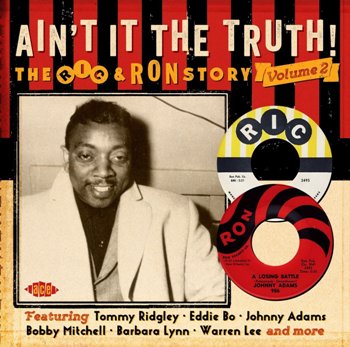
RIC & RON + BOPPIN’We stay in New Orleans, but now focus on Joe Ruffino and his Ric & Ron labels, named after his two sons. Ain’t It the Truth/the Ric & Ron Story, vol.2 (Ace, CDCHD 1416; 24 tracks, 60 min.; notes by Tony Rounce) covers the years 1960 – ’63. The first volume, You Talk too Much, was released earlier this year. There are twelve artists featured on the comp and the music varies from rhythm & blues to blues, rock ‘n’ roll, pop, novelties and early soul. Mostly we’re treated to uptempo, good-time sound - fun music. The showman Eddie Bo specializes in those novelty type of dancers – Ain’t It the Truth Now, Check Mr Popeye and Baby I’m Wise, the early incarnation of Slippin’ and Slidin’ – but also Joe Ruffino’s shoutress, Martha Nelson or Carter, recorded loud and robust beaters (Then I’ll Believe, for one). Bobby Mitchell cut a fast rock ‘n’ roll number called Mama Don’t Allow, but his second contribution on this CD, Send Me Your Picture, is, on the contrary, a powerful rhythm & blues ballad. Warren Lee has listened to Ya Ya for his Unemployed, and Joe Louis has had Stagger Lee in mind when cutting Country Boy. Jimmy Esterling created a sugary pop ballad called I Guess I Always Will, but on the “pop & fledgling soul” front Tommy Ridgley is surpassing with the fast Honest I Do and the uptown-ish In the Same Old Way. His Should I Ever Love Again is a slow swayer, not far from the Fats Domino territory. However, there’s one above others – Mr. Tan Canary, Johnny Adams. He has as many as five tracks on this set, one of which is a demo, How Come and Why, with only a guitar backing. Incidentally, the other demos on the set are by Barbara Lynn (Found My Good Thing and Question of Love) and Al Johnson (Carnival Time). Back to Johnny, the highlights are the plaintive Life Is Just a Struggle and his two blues-tinged deliveries on a Losing Battle and Showdown. In terms of emotional expressive powers, Johnny was the best Joe Ruffino had. There’s also a new comp called Boppin’ by the Bayou/Made in the Shade (Ace, CDCHD 1415; 28 tracks, 61 min.; notes by Ian Saddler) featuring music from South Louisiana and Southeast Texas, but it’s crammed with rockabilly - with relevant hiccups - rock ‘n’ roll, pop, country and a bit of zydeco. This is the ninth release in the Bayou series and it has nothing to do with black music. This one is for you, you all little teddies (http://acerecords.co.uk/boppin-by-the-bayou-made-in-the-shade). 
BRENTWe travel to New York for Brent, Superb 60s Soul Sounds (CDKEND 420; 24 tracks – 10 unissued at the time - 58 min.). This Bob Shad’s label released 76 singles between 1959 and ’67, and on this compilation in his liner notes Ady Croasdell cleverly divides the tracks on display geographically. Shad’s music was recorded on the West Coast & L.A., in Detroit, New York, Florida and even Phoenix City in Arizona. Bob was first aiming at the pop market, but later more at the soul scene and especially the club-goers. Consequently there are only four downtempo tracks on this comp and the two that stand out are I Love You, Baby by the Moovers – a Chicago type of a sweet soul serenade – and the rough Begging You by a teenager named Ronnie White. Here and there you can detect traces of influence by other artists. On I Want Love Brenton Wood’s vocalizing bears a resemblance to Billy Stewart’s style, whereas on Cross the Bridge you can hear the Drifters. On Marvel Harrell’s uptown track, Don’t Play with My Heart, Ben E. King is the model. Also on an early-soul weepie titled Someone (Who Needs You Like I Do) by Bertha Tillman that someone has listened to The Great Pretender. Among many indifferent dancers and stompers there were some goodies, too. Dave Crawford’s Praying for the Rain to Come is a solid and steady uptempo number, the Moovers’ – later Livin’ Proof - One Little Dance is a bright toe-tapper, Clyde Wilson’s Go to Him is a dramatic uptown cut alongside Varetta & the Thomases’ similar Fly by Night. Jeannie Trevor’s Tinklin’ Bells leans on pop but as a dancer it’s quite spellbinding. 
COUNTRY MEETS SOUL AGAIN *Kent’s popular country-soul series has really deserved its success. Cold, Cold Heart/Where Country Meets Soul, vol. 3 (CDKEND 422; 24 tracks, 78 min.; notes by Tony Rounce) is again a thoroughly enjoyable and musically fascinating set. We even can taste a bit of Motown this time with the Temptations’ Little Green Apples – led by Paul Williams – and the Supremes’ It Makes No Difference Now, led by all three ladies. On the rougher side the Mirettes (Stand By Your Man) and Gornell Gunter & the Cornells (Wishful Thinking) excel, whereas among the many melodic and beautiful slow songs my picks would be the pleading Touch Your Woman by Margie Joseph, the floating Easy Loving by Bo Kirkland & Ruth Davis, the magnificent Another Man’s Woman, Another Woman’s Man by Laura Lee, the vulnerable Till I Get It Right by Bettye Swann, the classy Tender Years by Brook Benton and My Woman’s Good to Me by the young George Benson in 1969, and here he sounds a lot like Al Wilson. Add to the list still Too Late to Worry, Too Blue to Cry by the distinctive Esther Phillips, Long Black Limousine by O.C. Smith (see his complete story at http://www.soulexpress.net/ocsmith_story.htm) and two more recent records, Whenever You Come Around by Little Milton and When I Think about Cheating by Willie Clayton. This set offers once more both heartbreaking, and uplifting songs, which don’t leave you cold but make your emotions flow. 
BLACK BOOKCASEMOTOWN ENCYCLOPEDIAAs most of you know by now, Graham Betts’ Motown Encyclopedia (ISBN 978-1500471699; AC Publishing; 588 pages, no photos) is now available also as a printed book. Graham has earlier written books on pop music, U.K. charts and football, but now he has done a profound research on Motown and all its subsidiaries and included 1178 entries from the period 1959 till 1988. Among the entries there are not only the artists, but also hit songs and albums, compilations, the labels that Motown distributed and movies and TV specials. At times it seems that Graham has included everything that even lightly touches Motown, so this is a good book for perfectionists. Although there are some small inconsistencies with my own interviews with some of the artists (Dennis Edwards, Freddie Gorman, Frances Nero, Chuck Jackson, Gerald Alston) and to the entry of “Fingertips” and “Thomas ‘Beans’ Bowles” as further reading I would have added the book Fingertips/The Untold Story, those are only minor and insignificant details. This is an excellent reference book and a must for all Motown fans. © Heikki Suosalo Back to Deep Soul Main Page Back to our home page |
