THE MARGIE JOSEPH STORY, PART 3: KNOCKOUT Margie Joseph performing at Soul4Real Festival. Photo courtesy of Luis Solsona. Margie: “I stopped. I only sang in church. I didn’t sing anywhere else. I was living in New Orleans. I had two more children, so I was being a very attentive nurturing mother. I had a daughter born in 1980 and my first son was born in ’81. I didn’t have time to do anything, because they were back-to-back. In fact, I didn’t go back to teaching until after the Knockout era.” Although Margie’s five albums for Atlantic Records in the 1970s were of high quality – featuring strong production, arrangements and deeply soulful performances – they never achieved major commercial success. Her collaborations with Lamont Dozier (Hear the Words, Feel the Feeling, 1976) and Johnny Bristol (Feeling My Way, 1978) are now especially well regarded. Frustrated by the lack of success, Margie withdrew from the music industry for nearly five years, though she never fully abandoned it. DEXTER WANSELGrammy Award winner Dexter is known best for his extensive work with Philadelphia International Records. There, he served as an A & R director while also writing, producing and arranging for major artists such as Lou Rawls, Patti LaBelle, Teddy Pendergrass, Phyllis Hyman and the Jones Girls. He was also a conductor and keyboardist for MFSB, and earlier performed with Yellow Sunshine and Instant Funk. Born in 1950, Dexter began his music career at just eight years old as an errand boy at Philadelphia’s Uptown Theater. By the age of twenty, he had already established himself as a leading synthesizer talent at Sigma Sound Studios. Of his four solo albums released on PIR in the 1970s, Life on Mars (1976) remains the best known. His more recent release, The Story of the Flight Crew to Mars, dates from five years ago Margie Joseph was one of the artists that Dexter worked with. The 1976 Live! album featuring Margie, Blue Magic and Major Harris was released on the WMOT label, and the results of Dexter’s and Margie’s musical collaboration after that were supposed to be released on WMOT as well. Margie: “Dexter had a goldmine waiting for me. That would have been an awesome album, because I had moved into that Philly sound. Dexter wanted me to sing a song called I Can’t Forget, and I really wanted that record to be my next single.” I Can’t Forget is a power ballad written by James Herbert Smith and Terri Wells, and Dexter produced it later on Patti LaBelle in 1985. In 1978 Fantasy took over distribution of WMOT from Atlantic and two years later WMOT began distributing independently. In 1984 the label ceased to exist, partially due to lawsuits over money laundering. Margie: “Dexter only got a chance to record a few songs, not an album.” Those tracks remain hidden somewhere in vaults. ON A HIGHER PLANE WITH AL GREENIn 1981, Margie visited American Music Recording Studios in Memphis, where Al Green was recording his gospel album Higher Plane for Myrrh Records. Margie: “I did that project with him with hopes that I would see some manifestation of good things out of it.” Although the album won a Grammy Award in 1983 for Best Contemporary Soul Gospel Album, Margie did not benefit directly. “We wrote a song called The Spirit Might Come, and I didn’t get any writer’s credit for that. I worked with Al on three songs, and I did People Get Ready with him, too.” Margie contributed background vocals alongside Laura Lee, Wanda Neal Bobo, and James Nelson. On People Get Ready, Al duets with his romantic partner at the time, Laura Lee. The writer credits for the slow and impassioned The Spirit Might Come – On and On go to Keith Burke and Morgan (!) Joseph. The third song on which Margie sings in the background is a bouncy mid-pacer called By My Side, and here the writer credits go to the keyboardist Johnny Brown and again to the mysterious Morgan Joseph. It would be interesting to know who received Morgan’s royalties, as the album was reasonably successful and presumably to a degree profitable, too. A SINGLE CALLED “KNOCKOUT”Margie’s music hiatus ended in 1982 with the release of a disco hit Knockout. The single reached # 12 on Billboard’s Hot Black Singles chart - her third-highest chart position - losing only to My Love in 1974 (# 10) and What’s Come over Me in 1975 (# 11). On the Dance Club charts it reached # 32. In the U.K. Knockout (Special Mix) was released in April 1983 (on Jive 32). Margie: “Walter Moorehead was an ex-promotion man, and he came by my house in New Orleans and told me that Harvey Lynch was interested in signing me. Then I went to Memphis. I was with Tom Jones III and David Weatherspoon through the whole process of recording the Knockout album. We rehearsed together. In fact, I stayed in Tom’s house in Memphis.” Harvey Lynch also became Margie’s manager at that point. Born in 1940, Walter Moorehead hails from New Orleans. As a youngster he got hooked on Dave Bartholomew’s music, and after gaining more experience on the business side of the music industry, he was hired by Atlantic Records in the late 1960s for a promotion role, with his first task being to deliver records to radio stations. Later in life - besides producing, arranging and writing for numerous artists - Walter also ended up singing on some of their records. Jean Knight was one of his collaborators. 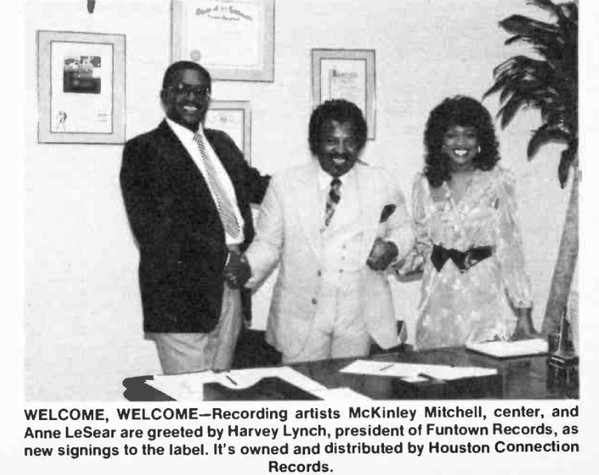 Harvey Lynch was the owner of the Houston Connection Recording Corporation (HCRC) and he had a backer in the oil business in Houston, Texas. The label was founded in 1981, distributed by CBS and – besides Margie - some of the other artists on the label included William C. Brown III, X-25 Band, William DeVaughn, Oliver Sain, a group called Glass featuring John Williams, Ellis Hall, Jr. and Anne LeSear. Alongside Harvey, Bobby Manuel and Jim Stewart were co-owners of the label. The writers of Knockout were Tom Jones, III (1951-2015) and David Weatherspoon, Jr., and the song was cut in Memphis. Bobby Manuel: “Tom Jones was co-writing with David Weatherspoon, when Jim and I recruited them. When Jim and I produced Margie’s vocals, William Brown was the engineer. The studio was owned by Jim and me, and it was called the Daily Planet. We built it after the fall of Stax and I had recorded Disco Duck in 1976. We gave Tom and David full credit on the record label.” Bobby produced most of the other artists on the HCRC label and played in their sessions. The funky and strongly pulsating Knockout was released in October 1982. Margie: “For the first time I had a hit record that appealed to record buyers. It was the kind of urban contemporary what the youngsters were doing at the time. In fact, people still love that song. I got a whole lot of gigs after that song, and every man I met wanted to be Mr. Knockout. The description of the man in the song was my second husband, so I actually was singing to him. He was the love of my life. The thing about Knockout was that it’s the original Margie. It doesn’t sound like Aretha or any of my other mentors. Dave and Tom gave me a contemporary song.” “But I also had to stop being a mama. Leaving my babies was very hard for me, because I was leaving two toddlers. I know they were safe with my mother, but that was the hardest part. Knockout brought so very much work for me. I was always gone – touring and performing – and my heart was always at home. I didn’t get paid all the performance royalties, but I made plenty money doing live shows, and people loved it. When after a couple of songs in the beginning the band hit Knockout, people would go crazy. That’s the first time I experienced that” “I remember the time, when disco appeared on the scene – Donna Summer and artists like that – I felt that wasn’t me, wasn’t my style. Tom kept his ear on the pulse of the music industry. Some of the songs I really like now, but I didn’t like them, when he presented them. He said ‘girl, you need to sing these songs.’ ‘But I don’t like the disco.’ ‘I don’t care what you like, you need to sing these songs.’ I was obedient to my producer, because I knew he hears things that I didn’t hear.” 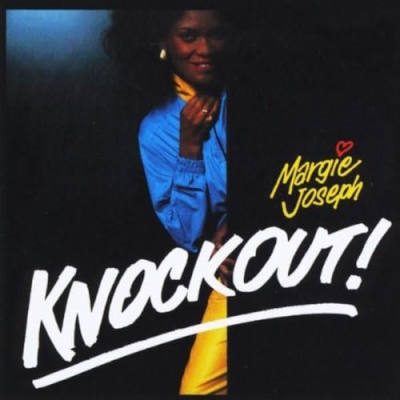 AN ALBUM CALLED “KNOCKOUT!”The album Knockout! featured seven additional songs written and produced by Tom Jones and David Weatherspoon. Many seasoned musicians played on these tracks: Lester Snell on keyboards, Michael Beard on drums, Jimi Kinnard on bass as well as on synthesizers with Mark Bynum. Bobby Manuel and Michael Toles played guitar, and in the string section there were as many as eight players. String arrangements were created by Lester Snell. The mix also included 13 background singers. The vocals were not cut at the Daily Planet but in another studio. Margie: “Most of songs on Knockout were recorded in Muscle Shoals and that album was produced by Tom Jones and David Weatherspoon.” 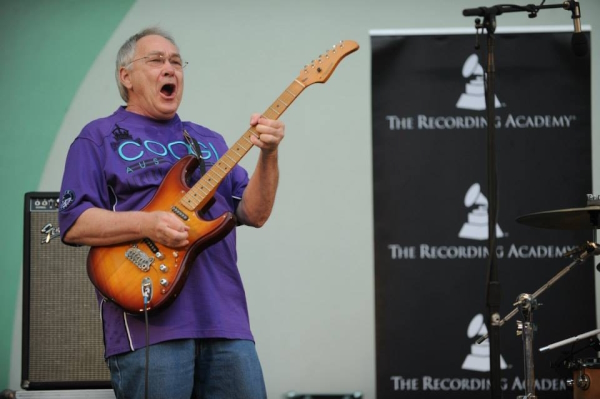 Bobby Manuel. Photo courtesy of Bobby Manuel. Today the most active of those music figures is Bobby Manuel, who produces not only the Blues Paddlers (No Turning Back for the Blues Paddlers | Soul Express), but works with many other artists as well. Bobby: “I’m working on a gospel album that should be ready in a couple of months.” HCRC released the second single off the album in April 1983. Move to the Groove was a disco dancer driven by Mark Bynum’s moog synthesizer, whereas the third one, released in July 1983 and titled Come and Make Love with Me, is an easily flowing, strings-laden sweet ballad. Unfortunately, neither charted. The music on the album is interestingly two-sided. Five tracks are run-of-the-mill disco dancers – such as Gonna Get You, Pull the Shade and Give It to Me – but then there are songs that make you stop in your tracks and give them a closer listen. The One You Can Trust is pleasant mid-pacer, which melodically bears a resemblance to Stephanie Mills’ Never Knew Love Like This Before, while I’m Blessed is a beautiful ballad that grows into gospely heights with a powerful choir. Along with Come and Make Love with Me, those three stood out for their musical depth. Knockout! reached # 34 on Billboard’s Black Albums charts in 1983, marking Margie’s last charting album. In 1984 Houston Connection Recording Corporation folded, because Harvey Lynch lost his oil tycoon backer in Houston. BACK TO ATLANTICMargie: “I was bold then. I was trying to raise my hand in the classroom and say ‘may I say something.’ I did call Henry Allen. Henry always did believe in me. He was interested in doing something with me also after Katrina (in 2005), when I moved to Atlanta. I love Henry and I miss him.” Margie worked with Henry Allen on her first Cotillion album in 1976 called Hear the Words, Feel the Feeling, and now eight years later they reunited for her album titled Ready for the Night (Cotillion/Atlantic). Recorded in January 1984 at David Rubinson’s Automatt Studio in San Francisco with Ken Kessie as the main engineer, the album was seventh to last in that widely adopted studio’s history. Ready for the Night was produced by Preston Glass and Randy Jackson. Narada Michael Walden was credited as the executive producer. Margie: “Narada was so much fun. He and Randy Jackson and Preston Glass were like the three musketeers. It was just a big party. The studio was like a nightclub. That’s the kind of feeling I got.” 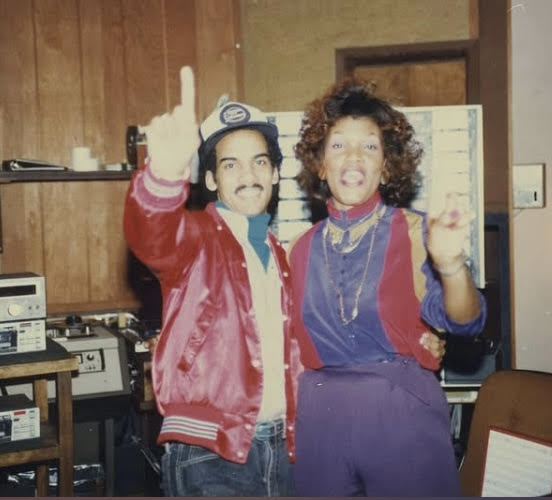 Preston Glass with Margie Joseph. Photo courtesy of Preston Glass. Multiple Grammy Award winner, Narada Michael Walden (https://www.naradamichaelwalden.com/) was born in Kalamazoo, Michigan, in 1952, and after having played drums and singing lead in the Mahavishnu Orchestra, he launched his solo career in 1976, released altogether eight albums on Atlantic and eight more on other labels. However, he is best known for his production work for such artists as Whitney Houston, Aretha Franklin, Gladys Knight, Diana Ross, Ray Charles, Mariah Carey and dozens more. 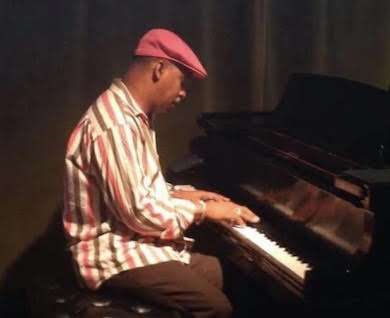 Preston Glass. Photo courtesy of Preston Glass. Preston Glass: “It was a great thrill to work on that album – as a co-producer. It was one of the first albums I received producer credit on. Margie was fun to work with, and a complete professional. She could sing anything.” Please read Preston’s bio in his own words: Deep Soul October 2021 | Soul Express. Not only the executive producer, Narada also played drums in Ready for the Night sessions, and among other musicians there were Corrado Rustici and Alan Glass on guitar, Preston Glass, Frank Martin and Walter Afanasieff on keyboards – Walter also on vocoder -, and Randy Jackson on bass and synthesizers. In the 5-piece backing choir you can spot one Jim Gilstrap. Songs were mostly written by Narada and Preston with some help from Liz Jackson, Randy Jackson, Bunny Hull, Frank Martin, Patti Austin (!) and Margie herself. Margie co-wrote a mellow and melodic dancer called Adonai. Margie: “That was my first attempt to appease grandmother by singing something in relation to the Lord.” The strings on this track were arranged by Jerry Hey. 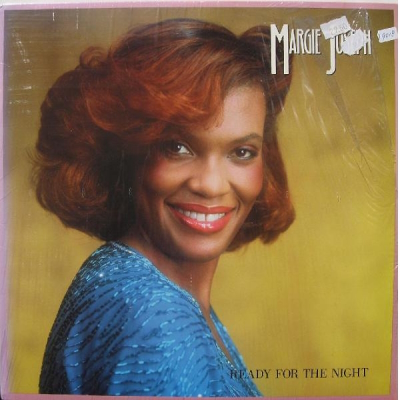 READY FOR THE NIGHTThe first single release was an electro-disco-funk number called Big Strong Man, backed with the similarly synthetic and hard-hitting I Wants Mo’ Stuff. On the latter one Jerry Hey arranged the horns – Jerry on trumpet and Marc Russo on saxophone – and one of the co-writers really is Patti Austin. Preston Glass: “Since Narada and I where in the studio working on a Patti Austin album at the same time as Margie’s album, Patti was inspired to help me and Narada write a funky jam entitled I Wants Mo’ Stuff.” Patti’s eponymous album on Qwest Records was released in March 1984. Although that first single missed the charts, the follow-up – the title song, Ready for the Night - hit # 69 on Hot Black singles chart, and it remains Margie’s last charted single in Billboard. The track follows the typical mid-1980s dance music pattern of using electronic drums, synthesizers and even my all-time hate machine, vocoder. Narada’s and Preston’s melody was hooky, though, which undoubtedly boosted its popularity, and - on top of it all - Margie’s vocal delivery is even stronger and sprightlier than is defined in the standards for these club dancing songs. Another perky boogie-funk number called Midnight Lover was released as a single in the U.K. on Atlantic, and it peaked at # 42 on local dance charts. Tell Me is the fifth dancer on this eight-track set and it was written by the producers of the previous album, David Weatherspoon, Jr. and Tom Jones III. Margie: “They admitted that to me, because we were going to do another album, and I liked the song. The way it sounds on this Ready album is the way Narada changed it to modify for the album.” 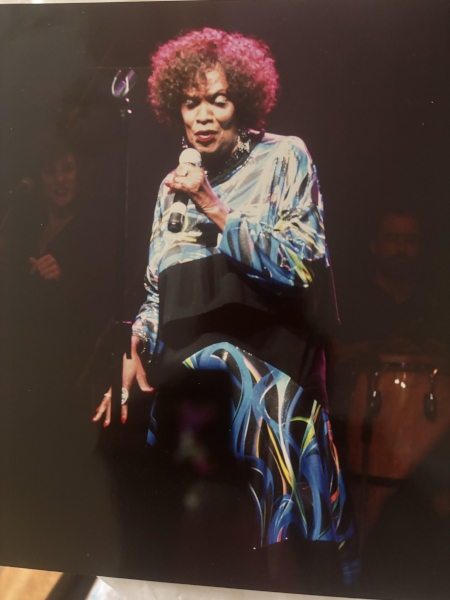 Margie Joseph on stage. Of the two down-tempo songs on the set, It’s Gonna Be Me and You is a sweet and romantic song, while the highlight of the album, Take Me Away Tonight, is a beautiful power ballad that became popular especially in Jamaica. Margie: “That’s a beauty.” Preston: “My personal favourite song on the album is Take Me Away Tonight – not only did Margie perform that magnificently, the song’s melody and lyric are very touching.” Margie’s inroads into the 80s disco-funk territory with Ready for the Night didn’t quite come off, as the album failed to appear on charts. Margie: “It was not promoted properly. That has always been the issue with me. It’s not that the albums weren’t commercially saleable, it’s the money that will be put behind them. I never had proper promotion. Knockout did itself. Nobody really had to promote Knockout. The deejays just loved it. When they heard it, they wanted to play it. There was nothing wrong with the Ready album. I think Henry Allen was getting ready to leave after that, because he had Sister Sledge also, and I found that they put more money on Sister Sledge projects than mine. I do believe that. We were signed at the same time.” Indeed, Cotillion Records closed down in 1986, and Sister Sledge along with some other artists were moved to the parent label, Atlantic. Preston: “Working with Randy Jackson and Narada in the studio was phenomenal – and Margie was so versatile and creative, that made my job easier. I don’t know why the album wasn’t bigger – maybe the label put out the wrong first single.” COMMUNITY WORK“If I wasn’t going to starve, I had to get a job. I thank God that I listened to my daddy. When Larry McKinley wanted to record me after my graduation (1966), my daddy said ‘you will get your degree, because you’re going to need a job.’ I’m glad that most of the time I obeyed my parents. I was able to go through another aspect of a career that I love. That was taking care of needy children and people.” From 1984 onwards for about four years, Margie focused not only on her family, but also on community work. “Head Start” is a comprehensive, federally funded U.S. program that provides early childhood education, health, nutrition, and parent-involvement services to low-income children from birth to age five. “At first, I was working under the actual director, and there were times, when I had to move into that slot, when the director was on leave for a long term. The Head Start program is like a pre-kindergarten program. It’s a wonderful program, and it took off, because it was income-based.” After Head Start, Margie worked as a community resource director at United Way, which is a global network for community action. 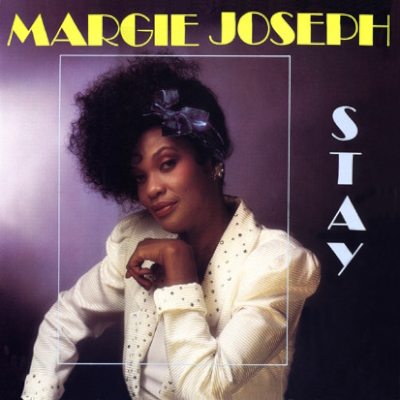 STAY“I was still hawking, trying to resurrect my career, and called John Abbey. He had been the head of the Blues & Soul magazine. He used to do articles on me. His record company Ichiban was Atlanta, Georgia based. At that point I didn’t know that I would end up living here years and years later.” John Abbey and Nina Easton founded Ichiban Records in 1985, and – besides promoting southern hip-hop – the label released a lot of material from classic soul music era artists, such as Prince Phillip Mitchell, Billy Paul, Barbara Lynn, Clarence Carter, the Three Degrees, the Dells, only to name a few. 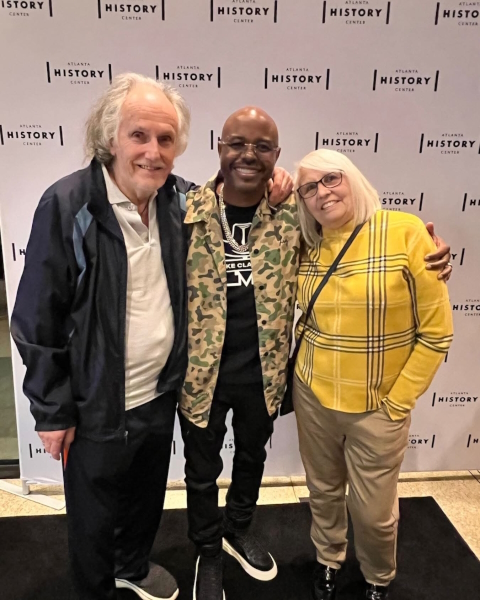 John Abbey, DJ Smurf and Nina Easton. Photo courtesy of John Abbey. Margie’s next recording sessions took place at Sound Lab. in Atlanta, Georgia, in 1988. Winton Cobb and Sheryl Martin produced an 8-track album titled Stay for Ichiban Records. Besides Winton and Sheryl, other musicians on the set included Lester Jordan, Trammell Starks and Anthony Shockency on keyboards, Anthony on guitar as well, and Mark Adams on electric bass guitar. Drums were programmed and “all instrumental & vocal sampling by DCO Lab Techs.” Margie: “I say this very boldly. John was not pleased with that album. John did not have hands on. I thought John was going to participate as one of the three major producers and have more input. The people he turned the project over to – they were talented, but we rushed that project. It really wasn’t completed, because we didn’t add sweetenings to it. We didn’t really put everything into finding good songs for that album. I know that John was not pleased with it, but I think he should take 50 % of the blame, because he had gone back to England. He was never there. I didn’t know that he was dissatisfied with that album, until it was time to press it and try to get it out there.”  John Abbey. Photo courtesy of John Abbey. John Abbey: “I love Margie. As a person and as a talent. But she’s wrong. I take 100 % of the blame. Shortly afterwards we changed the whole structure of the company and if the project had happened a year later, I am sure we would have been much happier together. Let’s just say it was a difficult time for the company and my efforts were elsewhere. Not from choice because I wanted very much to be involved in the project. I have and had the greatest respect for Margie. Timing is always crucial in this business. If only we could turn back the clock.” I’VE GOT TO HAVE YOUR LOVEThe first and only single off the album featured two songs that Margie co-wrote. I’ve Got to Have Your Love is a mid-tempo ditty with a heavy beat. Margie: “That was never finished. It was left as an empty track to me. We really must try to do something with that song.” Smile, These Are the Best Times on the flip is a big-voiced up-tempo stomper. Margie: “I and the co-producers got together, and I think we were probably talking about something, and I said ‘you know, smiling is my thing.’” Margie: “The whole album is not bad, because I’m the one who chose the Womacks song.” The album kicks off with the smooth and melodic Love’s Calling, which Cecil and Linda Womack had recorded three years earlier on their Radio M.U.S.C. Man album. The song really is a positive and sunny opener, and Margie’s vocals are crystal-clear. Also, the very song Radio M.U.S.C. Man is covered on this set in a vigorous way. Probably the best song on the set is Henry Davis’ big pleading ballad called Stay. Margie: “Jeffrey Osborne, a friend of mine, called me while I was recording and asked me just to record that song. I think that’s the best performance - between that and Love’s Calling.” The group L.T.D. with Jeffrey on lead had first recorded the song under the title of (Won’t Cha) Stay with Me on their 1977 album Something to Love. A mid-tempo toe-tapper named Cinnamon Rosy Cadillac sounds like a nursery rhyme, and here the song is credited to Sheryl Martin and Mark Ford. Margie disagrees: “I wrote that song, because I ended up in Cinnamon Rosy Cadillac at that time.” Gino Vannelli released his soft rock song titled The Wheel of Life in 1978, and on this set, Margie turns this gentle ballad into a more soulful and more big-voiced number. Skip Scarborough (1944-2003) wrote a ballad named Love Changes for Mother’s Finest in 1978. Margie’s delivery is more intense and passionate. Margie: “I chose that too. We were just searching for good songs that we thought were radio-orientated and would give us good airplay. I covered Love Changes, because that was one of my favourite songs.” Margie: “I’m glad that John gave me a shot, an opportunity to try to resurrect my career. I even got a chance to meet him and his beautiful family. I love him still.” John Abbey: “I am still managing the Three Degrees after 36 years. The city recognized Ichiban’s contribution to Atlanta last year and Nina Easton attended. It was a great evening and for me a great honour.” SECOND HIATUSStay remained Margie’s only solo album on Ichiban, but in 1994 in their “Ichiban Soul Classics” series they released a fine compilation titled The Atlantic Sessions/The Best of Margie Joseph (https://www.45cat.com/cdalbum/cd/scl25032). This 14-track compilation was produced by David Nathan, “British Ambassador of Soul”, and he also wrote the liner notes for it. If you wish to get acquainted with Margie’s product on Volt Records, prior to the Atlantic period, there’s a comprehensive compilation that was released in the U.K. in 1993, and in the USA in 1999 (https://www.discogs.com/release/2197222-Margie-Joseph-Makes-A-New-Impression-Phase-II). Disillusioned, Margie left the music business again in 1988. Margie: “I went back to work. I was a marketing specialist for girl scouts of America. United Way started another program. I was not a lazy woman. I’ve always worked.” Those days Margie contacted also Malaco Records, but it didn’t yield any results. Margie: “That hurt my feelings, because I was a Mississippi girl. I was right there on their nose and I’m trying to get to them and they didn’t want me. That hurt my ego. I was almost begging them. Maybe they didn’t have room for another female singer. Maybe I sounded too much like the ones they had.” “I was very busy getting my children through high school and college. I didn’t have time for record business. My career ended so I could help, develop and guide my children, because I could see that the world was going to be a challenging place. Hip-hop and rap had come out. There was a lot of cursing in music. I crushed many CDs, so that they couldn’t listen to that – if I found them (laughing). My husband and I, we just delt with rearing our children. He was buying them cars and jewellery. I was more disciplinarian, so I had to be home. I didn’t have time to chase no dream. If you bring children into the world, you are responsible for their souls. And I’m so proud of my three children now. They are awesome.” 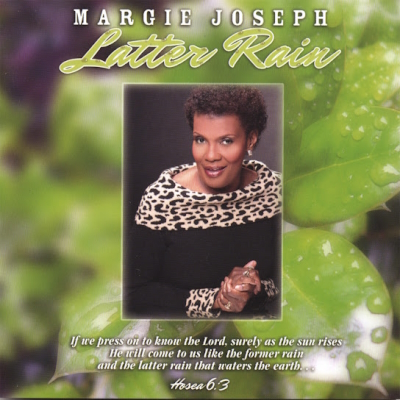 LATTER RAINMargie’s second hiatus from recording new music was not a break of four years this time, but as long as eighteen years. Her last album titled Latter Rain was released in 2006. The project was deeply personal and spiritually driven. Margie: “Let me tell you about the genesis of Latter Rain. My grandmother and my aunt, who practically reared me and my mother, would always tell me ‘You should be singing for the Lord. You are singing for the devil.’” “I was actually in hurricane Katrina (in 2005). I had sent my children up to Atlanta to my sister. My husband and I actually stayed at the house. A lady named Susan Tapper called. She woke me up. I think she was looking for me for David Cole (the editor of “In the Basement” magazine). Susan is a wonderful spirit, very knowledgeable and very resourceful. We bonded. She was managing Winfield Parker. I did some shows with Winfield in Maryland, and she got interested in me. I wanted to do a gospel album. The title Latter Rain was given to me by the Holy Spirit. So, the hurricane Katrina is related to me getting back on my feet.” The musicians on the album include Kenneth Brandon on piano, Darrin Christopher Jennings on keyboards, Mark A. Smith & Uni’Tee on drums, keys and percussion. Steve Brooks sang background vocals. Margie: “The first group of musicians that I approached were local, from right there in Biloxi, not far from me. We started the project. Then Katrina happened. I didn’t complete Latter Rain, but I had the CDs with tracks on them. I wanted to get that finished.” “Now Dale Ramsey came on the scene. He hasn’t got his dues. He’s awesome. Susan and I turned that project with the music to him. Dale did a phenomenal job. If you’d hear that original music compared to what the album is now, you wouldn’t believe it’s the same project. Dale has a studio in his basement. He lives in the Gwinnett County, Georgia.” “I was told once by a preacher that when you sing gospel songs, you should be able to emulate the song to scripture in the Bible. That’s when I started choosing songs that I could find a scripture in the Bible. On the cover of that album, I’ve listed a Bible verse for every song. That’s how important the Latter Rain project was for me.” SISTAHPRAISEDale Ramsey not only produced and mixed the music on the set, but he also played guitar, keyboards and sax on it and programmed drums. Hugo Mendez was the engineer. Latter Rain was released on Margie’s and Susan’s Sistahpraise label in 2006. Margie: “Susan and I came up with the name ‘Sistahpraise’, because we used to call each other ‘sistah.’ We bonded like sisters. I would stay with her, and she would come by and stay with me in Georgia, and we still have that sisterhood relationship. We wanted to have our own label, and we hired Walter Morehead to be our promotion man. The reason why the record wasn’t a success was that we ran out of money.” The hypnotic title song Latter Rain opens the album, and this Dale Ramsey’s inspirational beat-ballad runs close to 8 minutes. It sounds like Margie is supported by a big choir. Margie: “It wasn’t a choir. It was a group of people that Dale Ramsey put together.” Latter Rain is followed by an intense and big-voiced ballad titled I’ll Bear You up on Eagle’s Wings. “That’s the quotation from Exodus, 19th chapter.” Herbert Brewster’s Move on up a Little Higher is like a ragtime downtempo song, almost aggressive. “That comes from Mahalia Jackson, who was one of my very favourite gospel singers.” On I Will Always Sing for Jesus Margie explains in her monologue that she’s singing for Jesus on the advice of her grandmother. Actually, there’s not much singing on the track, and at the end on vocals Margie is joined by a group of children. Spirit of the Lord Says Come is a beautiful and peaceful ballad, which Margie delivers in a quite sensitive way. Cassietta George of the Caravans recorded Walk around Heaven in 1964 and since then the song has been covered by Paul Beasley, Shirley Caesar, the Mighty Clouds of Joy, Patti Labelle and numerous others. Margie’s interpretation on this set is quite intense. “We took it from the very basic gospel song and made it kind of bluesy. That was Dale Ramsey again.” The 7th and concluding song on the set is a slow testimony titled When Jesus Walked, He Walked for Me, which also runs close to eight minutes and features some really wonderful singing from Margie. “Susan and I wrote that together. It was to be released during Easter. I always wanted that song to be released as a single.” “I had great aspirations for that album, but it takes money to promote. We didn’t know anything about approaching major labels, who could have picked it up. After Latter Rain the business wore me down. I kind of surrendered. And I had to focus on my children, and I’m happy to rear eight grandchildren. Life moved on.” 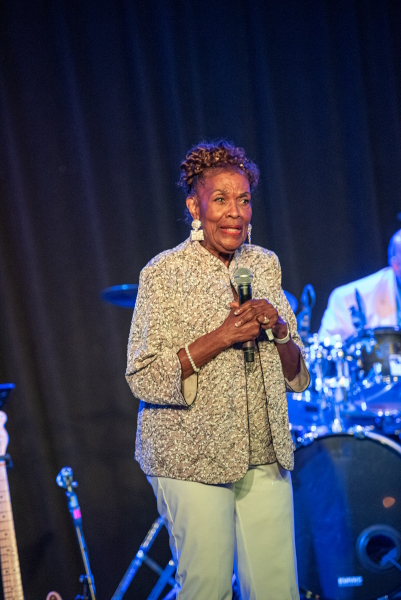 Margie Joseph. Photo by Jonathan Mason. Courtesy of Charles Mitchell. LIVE ON STAGE IN EUROPEAlthough we had to do without new recorded music, Margie however delighted us every now and then with live performances in festivals and various concerts. Already in the 1990s she was close to attending Europe’s leading soul music festival in Porretta, Italy. Graziano Uliani, the head of the Porretta festival, recalls: “In 1996 I heard that a supergroup put together by the Ichiban label was going to the Montreux Jazz Festival. The lineup included the Sweet Inspirations, Dee Dee Warwick, Jackie Moore, and probably Margie Joseph. I contacted Claude Nobs’ staff, and it seemed like they might be able to come to Porretta as well. Unfortunately, a few weeks before the festival, everything was cancelled. I managed to get the Sweet Inspirations to come, but not the rest of the Ichiban cast. I would have loved to have Margie.” Claude Nobs (1936-2013) was the founder and general manager of the Montreux Jazz Festival. In June 2018 Margie sang four songs at the 3rd Blackpool International Soul Festival in the U.K., where she starred along with Patti Austin, Eloise Laws, Ann Sexton and Nolan Porter. David Nathan interviewed her then and still remembers her fondly: “She was very lovely. I’ve found her very easy to talk to. She was very pleasant and she’s really great.” David, of course, had interviewed Margie earlier, like in 1976 at the time of the release of the Live! album and later during John Abbey’s Ichiban tour. 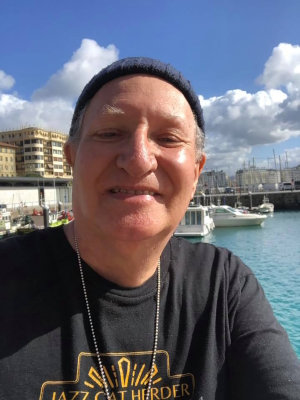 David Nathan. Photo courtesy of David Nathan. David also found and licensed from Atlantic/Warner Music Group a few unreleased Margie tracks, such as her versions of Elton John’s Don’t Let the Sun Go Down on Me and Barry Manilow’s and Adrienne Anderson’s Could It Be Magic. Margie’s interpretation of the Temptations’ 1965 hit, It’s Growing, was released on the Atlantic Unearthed Soul Sisters CD in 2006 on Rhino. David produced the compilation and wrote the liner notes. Originally, Arif Mardin had produced that Smokey Robinson-Warren Moore song on Margie in September 1972. “Soul4Real Weekenders” (https://soul4real.es/) attracted music fans from all over Europe - and elsewhere, as well - to Bilbao in Spain. The event was launched in 2000, and Soul4Real live concerts were added in 2013 and those soulful performances on stage existed till 2023. The only artist, who performed there twice, was Margie Joseph. Alex Subinas was one of the three main organizers of those weekenders. Alex: “Her first appearance was in 2017, when she sang a repertoire of eight tracks – basically her most celebrated 70s recordings, plus some of her late 60s sides for Volt. Sharing the bill was Lenny Williams. The backing band for both artists was a 15-musician orchestra, including strings and horns – the same orchestra we used every year for all the soul singers performing in Bilbao. The audience reception to Margie was phenomenal, and it was an emotional moment for both her fans and herself, as she had not performed these songs live in 40 years. Margie had a fantastic time in Bilbao, socializing and meeting all her longtime fans from Europe and the UK.” “Her second appearance was at the last edition of Soul4Real in 2023, which was very special as well. On that occasion, she performed only a few songs and shared the bill with the late Ann Sexton and David Sea.” GOOD VIBES AND HEARTFELT LOVEMargie: “In 2023, when I left Bilbao, I decided to hang up my rock ‘n’ roll shoes. I had the thyroid surgery, which was administered in 2018. When I woke up, the anaesthetics damaged one of my vocal cords. Then I lost confidence, and I didn’t sound the same. That kind of provoked me into saying ‘just give it up, because you never sing the way you sang.’ Between the loss of my husband in 2016 and the loss of my voice – those are the two greatest losses in my lifetime. In Bilbao in 2023, I still had some power in the vocal cords, but I wasn’t working frequently. I lost interest. I didn’t try to do anymore vocal therapy, so my voice got weaker. I couldn’t continue to sing. I didn’t sing but one song at Jus’ Blues.” Margie received The Jus’ Blues Legend Lifetime Achievement Award in Biloxi, Mississippi, in July 2025. “Now I dream about doing voices for animated movies, and even sing in them.” While on the subject of movies, there actually exists a documentary on Margie’s life. “A couple of guys out of England were shooting it, and their investor in New York tried to sell that documentary to big filmmakers, but he wasn’t successful. I told him that when I die, they’ll take it” (laughing). “I am grateful and remain humble for what achievements I attained. I enjoy helping people and administering children ministries in church and the community. I have a Homeless and Feeding ministry fully funded by me. It is called Cover Me Ministry. It’s a street ministry, where I provide food and clothes and words of God. That keeps me busy. The disparaged poor being neglected has become a major deficit in our world and I feel the poor has been forsaken. I’m glad that I’m busy, so it doesn’t give me any time actually think about negative things.” “I have 3 adult children and 8 grandchildren. They are highly educated and very prosperous in their specific careers. We all live in the greater Atlanta area. I have dedicated my life also to my children, grandchildren and my elderly mother. One of my next goals is to let the world hear my little protégé, my 22-year-old granddaughter. She’s awesome. My first born daughter, who was born in 1970, is an inspiration to use my acquired college degrees after my break from business.”  Margie Joseph's granddaughter. “I just love music. I’m still in this mode. where I start with gospel in the morning, and end up with the blues at night. I like country & western, and I enjoy jazz. I’m a different person now. Life has taught me some valuable lessons about what to be grateful for and what to be glad you didn’t get into in this business” (laughing). “My purpose in life outside of creating good vibes, energy and music is to support people where they need help and demonstrate my heartfelt love for the beautiful earth and people. Money is good but not my master. I spend it as quickly as I acquire it. I work very hard at whatever and whenever I find a need and must live in the power of now – not tomorrow, because it doesn’t exist until I live and see it. Past doesn’t exist anymore, so I don’t dwell in it. I have no regrets, because I forced to do life My Way.” “I am forgetting those things that are behind me, and enjoying the present yet I press forward to new goals which are higher callings for richer rewards!. Thanks to everyone who contributed to the experience… I was able to survive and I’m still here!!”
SINGLES (Label / titles / # Billboard placings: soul/pop / year) Houston Connection Recording Corporation (HCRC): HC7-31200)Knockout (# 12-black) / part 2 (1982) HC7-31500)Move to the Groove / instr. (1983) HC7-31900)Come and Make Love with Me / Give It to Me Cotillion 99737) Big Strong Man / I Wants Mo’ Stuff (1984) Cotillion 99771) Ready for the Night (# 69-black) / Is It Gonna Be Me &You Ichiban 88-145) I’ve Got to Have Your Love / Smile, These Are the Best Times (1988) ALBUMS KNOCKOUT! (HCRC, HLP-20009; # 34-black) 1983 Knockout Special Mix / Moove (sic) To the Groove / Come and Make Love with Me / Gonna Get You // Pull the Shade / The One You Can Trust / Give It to Me / I’m Blessed READY FOR THE NIGHT (Cotillion/Atlantic 90158-1) 1984 Ready for the Night / Midnight Lover / Take Me Away Tonight / Big Strong Man // Tell Me / Is It Gonna Be Me & You / I Wants Mo’ Stuff / Adonai STAY (Ichiban 1027) 1988 Love’s Calling / Stay / Cinnamon Rosy Cadillac / I’ve Got to Have Your Love // Radio M.U.S.C. Man / The Wheels of Life / Love Changes / Smile, These Are the Good Times LATTER RAIN (Sistahpraise, SP700) 2006 Latter Rain / I’ll Bear You up on Eagle’s Wings / Move on up a Little Higher / I Will Always Sing for Jesus / Spirit of the Lord Says Come / Walk Around Heaven / When Jesus Walked He Walked for Me Margie Joseph’s discography of albums, compiled by Ismo Tenkanen: https://www.soulexpress.net/margiejoseph_discography.htm (Additional acknowledgements to Bobby Manuel, Preston Glass, John Abbey, David Nathan, Alex Subinas and Graziano Uliani) © Heikki Suosalo The Margie Joseph Story, Part 2: The Atlantic Years (1972-1978)The Margie Joseph Story, Part 1: A Phoenix Rising (1950-1971)Back to Deep Soul Main Page Back to our home page |
