 INTERVIEW WITH MARVIN SEASEWhat is the thing that first comes to your mind upon hearing the name Marvin Sease? How do you associate him? Is it the sticker on his albums informing “parental advisory, explicit lyrics”, or is it the often-mentioned Tyrone Davis connotation? Actually Marvin is much more than those usual generalizations. We seem to take him for granted. We seem to like him, but somehow can’t recognize his real stature. He belongs to that strange group of artists that just keeps on churning out goodies but for some strange reason is off-mainstream. I hope that this feature in its own small way serves as a good reminder of the fact that Marvin is a very popular contemporary R&B artists and a big album-seller. Marvin, who was born in a little farming country town called Blackville in South Carolina in 16.2. 1946, was raised in a family of thirteen children. “I used to sing in school in the morning time the school song. Everybody wanted to hum and sing the school song. I had this unique Curtis Mayfield type of voice, when I was young, and I did deliberately try to sound like Smokey Robinson.” Smokey is still today Marvin’s number one artist. With his mother and father being church choir singers, it was only natural that Marvin was surrounded by gospel sounds. ”I really started from a group in Charleston, South Carolina, where I moved after leaving Blackville. I was like fourteen. I started singing with the group there called The Five Gospel Singers, where a guy by the name of Al Lee taught me a lot about what I’m doing even today. I stayed with the group till I was nineteen. After that I moved to New York.” Sneaking out of heavenly music, Marvin also experimented with secular sounds. ”At one point I sang with my two brothers, Charlie and Harold, who were known for a short time as The Sease Brothers. We had something like a Temptations type of group, but it didn’t last too long. I was about sixteen then.” Marvin has been a resident of New York ever since he moved over there in ‘66. ”That’s where The Sease Brothers really tried to come back, but we failed. I started singing with The Gospel Knights, and went then to The Mighty Gospel Crowns (no recordings). With The Gospel Knights we made a recording titled `He’s Coming Back’, and I did one called `Travelling On’ as a lead with The Gospel Knights. I think it was on Knights Records, I'm not sure, around ‘66 That was my first record.” Marvin’s guitar picking, which can be heard on some of his albums, derives from those days. ”I played guitar with The Five Gospel Singers, with The Gospel Knights and The Mighty Gospel Crowns. I don’t consider myself as a guitarist. I just know how to play a little, but I was good enough for those guys. On my stuff I play some, but I don’t do the main guitars.” Marvin’s final transition to R&B occurred after he had earned seventeen hundred dollars by doing a vacation show out of town with some hired musicians. ”After that I came back to New York and tried to put up a local band, because those guys were not for me. They were all working musicians. I formed a band, and I named them The Soul Keys. I did a lot of local shows and did gospel. I still stayed with the gospel group on Sundays, but then I got to the point that I didn’t like myself. I didn’t like what I was doing, singing gospel and blues, so I gave up the gospel. In ‘78 I said `I’m gonna go one hundred per cent and be a R&B singer’.” EARLY EFFORTSDuring the seventies Marvin had two singles released. The first one in ‘74 was on Double-M Records, the funky Looking For Something For Nothing, written by Melvin Madison and produced by Melvin, Marvin and Freddie Charles, coupled with the speedy Thankful For This Life (I've Been Given), written and produced by Freddie Charles. The second one was on Marvin’s own Early Records in ‘79, Is It Too Early Or Too Late backed with Let's Go To Disco, both produced and written by Marvin. ”I didn’t know what I was doing, and I never tried to release it with a bigger company. I just kept it and sold it locally.” In between and also in the eighties besides singing Marvin earned his living by doing different odd jobs. ”I was a house painter, a construction worker, worked on a beer truck, I picked cotton, I did everything. I’ve worked all my life.” Finally the big one came in the late eighties. ”In ‘87 my very first record was released on Polygram. I released that record, Ghetto Man, on my Early Records first, and that album (by the same name) was released on my label, prior to Candy Licker being on that album. We sold like thirty thousand copies in New York alone. Then I made a deal with Polygram, which they placed on London label. They wanted to put Candy Licker on that same album, and then they released it retitled as Marvin Sease.” The ten-minute Candy Licker is the top drawer on the album and almost like a signature song for Marvin. ”To tell you the truth the idea came to me in a dream, the beat, most of the lyrics, definitely the arrangement. I remember 4:30 in the morning it came to me. I was kinda depressed, because I was getting to record some stuff, but I didn’t have enough songs. I had a song called Let Me Lick Your Ice-Cream, but it sounded so comical to me. So I said to myself ‘I don’t think I really like this’. It needed something heavier, and that came to me. But when I first wrote it I said to myself ‘ there’s no way in the world I’m gonna sing this’. So I was beginning to try to find someone like Millie Jackson or maybe like Clarence Carter to do it. So my wife, who was my girlfriend at the time, inspired me to do it. I just didn’t feel comfortable singing the song, but I did. I’m glad I did.” The eponymous album on London in ‘87 was wholly written, arranged and produced by Marvin, as is the case with almost all of his material. It contains fine ballads with monologues (Let’s Get Married Today, Ghetto Man, Dreaming) and some soulful dancers to stir it up. It became a highly popular set, reaching the 14th place and staying in the charts for almost a year (according to Billboard). ”I think the public was hungry for what I wrote for that particular album. Dreaming was a splendid song to the public, it go a lot of FM airplay. The song Ghetto Man was the big record on that album. Candy Licker just came and drowned everything.” On one track, Double Crosser, Marvin’s style and vocals were for the first time compared with Tyrone Davis. ”Yes, lots of people compared it to Tyrone in the beginning. It’s just now that they’ve found out that there’s a difference between Marvin Sease and Tyrone Davis. That particular song has a lot of similarities to the Tyrone Davis style. It wasn’t intended. I was, what you would call, a versatile artist, and it was just something that I felt like writing that way.” After the success of the album Marvin could completely commit himself to music. ”I began to receive bookings like crazy. I don’t have what you call a main area, but I work more in the South than I do in the North. I’m excepted. It’s kinda funny, most entertainers with the style that I have, you would say that their biggest following would be in the South, but my concerts are evenly. I do as much in New York as I do in Mississippi.” 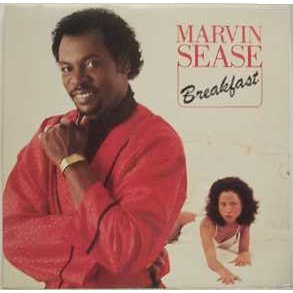 SAFE LICKINGThe second London album, Breakfast (in ‘88), offered three beautiful soul ballads – Same Old Woman, I Belong To You and the cream cut, Lately – but also an abundance of x-rated and at times musically irritating stuff (Condom On Your Tongue, I Ate You For My Breakfast, Tell Me). ”I thought the public wanted more of that, because of the success of Candy Licker. Then after that second album I started doing a lot of surveys on radio. We did a lot of call-ins to ask the public, how do they see me, what style would they like to see me. We found out that they loved me and what I was doing, no matter whether it was x-rated or not. So I came back and did a very clean The Real Deal album.” Breakfast also failed charts-wise, running for only two weeks and peaking at seventy-two. ”Polygram did a merger, when we released the Breakfast album, and I think it kinda got lost in the shuffle. I intend either to try Polygram to re-release the album, or I intend to re-record the Breakfast album, because I think it’s a great album.”  We both agree that Marvin’s third London set, The Real Deal (black-61, 33 weeks, in‘89), is his best yet. Super-machoism is gone and among Tyrone-reminders (Tell Me Why, I Made You A Woman, Live My Life Again) there are five ballads with the tender Right Don't Always Win being Marvin's own favorite of all the songs he has recorded. The only outside tune is the almost discoed The Thrill Is Gone. ”I've always admired B.B. King doing that song. I just have always heard it a little more up-tempo. That was just my opinion of the song.” In the sleeve-notes Marvin also thanks his band. ”I’ve always had a regular band. I don’t believe in house bands. Right now the band consists of four musicians and three singers, but I'm still looking for the fifth musician.” Show Me What You Got (Polygram / Mercury, black-72, 13 weeks, in '91) was almost as good an album as its precedent with a very catchy lilter called Missing You and a seven-minute version of Jerry Butler’s I Stand Accused. ”I’ve always admired that song. I didn’t quite do it the way that I wanted to do it, though.” One of the ballads, the soft and sensual Tonight, is Marvin’s first ever single to appear in the charts (black-86, 3 weeks). ”That’s the thing with the record company. I think they just don’t like to release a lot of singles on me. I think it’s the key to sell the album.” We also couldn’t avoid an action song this time, Don't ”Cum” Now. ”That was not intended to be the way it was. I’m spontaneous. Sometimes I go into the studio with one thing in mind, and leave the studio with another thing. That was not intended to be X-rated, but it turned out that way.” That year Marvin also sent his Season greetings by releasing an EP, It’s Christmas Time, on London (Merry Christmas / Funky Christmas / Do It Tonight / Take A Look Around). ”I was in the studio doing the Show album, when the company called and asked me, would I consider doing a Christmas album with Robin Harris. I agreed to do it right away. Robin and I were supposed to meet the very next week, but Robin passed away the next week. I didn’t have the time to do an album, so they asked me did I have enough to do a single and I said I could do at least four. I went on and did it.” JIVIN’& LICKIN’ After four albums Marvin left Polygram for Jive Records to release The Housekeeper album in ‘93 (r&b-55, 13 weeks) with mainly mid-to-uptempo bouncers, four ballads and a continuation to Breakfast called I Ate The Whole Thing (anybody remember Roy C’s answer song, I’m Not Going To Eat A Thing?). Once again, everything is done by Marvin, but he lists his manager, Joel Brooks, as an executive producer. ”Polygram was a great company. They just didn’t promote me the way I felt I should have been promoted. Jive found me. We ran an ad in Billboard that I was a free artist. Several record companies called. We did follow-ups and landed with Jive, because at that time Jive were known as the hit-makers. Everything that they touched became a hit.” Next year saw the release of Do You Need A Licker? (r&b-69, 5 weeks), which offered – although none of it was intentional – a Who’s Making Love sounding Hittin’ & Runnin’ and a Joe Tex (Skinny Legs And All) inspired Rockin’ Them Bones. Of the five slowies Stop The Pain is the deepest and I'm Sinking Down is Marvin’s rare excursion to straight blues. On his latest CD, Please Take Me (‘96), Marvin credits his wife, Alwillie, who among other things does her husband’s hair, and his two sons, Mark and Matthew. Marvin’s second marriage (eleven years) has produced one son, and there are five kids by his first marriage. The set opens with Candy Licker 2, a straight continuation to the original on the debut set. ”When I did Do You Need A Licker?, I was trying to do a Candy Licker 2, but I didn’t think it was gonna be strong enough to be considered in the family with Candy Licker. The public was still demanding that I do a Candy Licker 2, and, believe me, I intended to do Candy Licker 2 way before now. I tried so many times writing, and I just couldn’t come up with nothing. I definitely didn’t want to make Candy Licker 2 any worse than Candy Licker 1, and I think we did a great job on it.” Could this be an on-going series? Candy Licker 3, perhaps? ”I would have to be pushed by the public real hard, and it won’t be no time soon. I think it’s time to let the Candy Licker rest.” Marvin also offers one novelty track, a hillbilly jogger called I'm Not Your Judge. ”That is a song I wrote many, many years ago, but just never saw the right kind of opportunity to release it. Now that the public seems to except anything that I write and record, I wanted to sort of sneak that in, just to get the public reaction.” I'll Never Let You Go is spiced with a Caribbean beat. ”It does have a kind of Caribbean feel to it, but I didn’t like the mix we left it with. I wanted to bring the keyboards up a lot more to really let you feel the Caribbean beat. So I made a mistake. I intend to re-record that one at some point.” Among many smooth ballads there is one outside tune, Tonight Is The Night. ”I’ve always admired Betty Wright's Tonight Is The Night, and I wanted to do it just a little bit different. We did not want to title that song Tonight Is The Night, but the Betty Wright publishing company wouldn’t allow us to change the title name. We wanted to call it Tonight Will Be The Night.” These days Marvin is going back into the studio to start on the next album. ”I’m gonna do a change-up. I wanna get ahead and start on it, because it’s gonna be a little different music-wise. I’m going a little more r&b'ish. I must cross over in some kind of way. I feel like I’ve paid my dues. I think I’m qualified. I think the public has accepted me.” Heikki Suosalo Back to our home page |
